• How Song-Poems Paved the Way for Modern AI Artistry

    In the 50s and 60s, people would blindly send their poetry or lyrics, $50, and receive a 7” single of their work turned into a finished song. A professional singer would “sing” the words as best he could in one take, and session musicians would play along, template-style. The genre was mostly country and western, but studios turned out pop records.

    These mail-order song shops turned out tunes quicker than Berry Gordy did at Motown, but they did it with none of the passion or commitment to creating a work of art.

    There was no one name for these records, but they were sometimes called personalized records, custom singles, your own record, or even vanity records. There’s a documentary movie called Off the Charts: The Song-Poem Story, which claims ‘it’s estimated that over 200,000 song-poems have been recorded since 1900’, so let’s go with Song-Poem.

    Song-Poem Records: An Early Iteration of AI!

    I was recently reminded of Song-Poem records when a friend shared a video of Mark E. Smith’s record collection. Mr. Smith had a notorious Song-Poem record in his collection, and that sparked an epiphany-ah.

    Song-Poem records and large language models (LLMs) like ChatGPT operate the same way – people provide half-baked or even loony ideas, feed the machine (be it human or digital), and in return they get results ranging from dreadful to meh. Neither Song-Poem records nor AI require real talent, yet both can make anyone an artist, an expert, or just about anything one could dream of. In theory, anyway.

    Naturally, I turned to AI to research this lost phenomenon of trading fifty bucks of hard-earned cash for a vinyl copy of your words put to music. My adventure was fun, so I created this blog.

    I had AI write the story of Song-Poems in the style of an Alan Cross radio show/article.

    If you live outside of Canada, chances are you have never heard of Alan Cross. But he’s been on Toronto radio for as long, or longer, than Mark E. Smith fronted The Fall1, and he’s syndicated across Canada, including one show called The Ongoing History of New Music. Cross kind of takes an AI approach to his radio programs, gathering research and then reading his findings in a hokey yet ever-so-earnest voice.

    Check out Alan Cross’ website, A Journal of Musical Things, if you want to get a better understanding of what his work is all about.

    (And the bot did a pretty good job of emulating Mr. Cross, too!)

    DISCLOSURE: The rest of this post is AI-Generated.


    Everything Old Is New Again: The Secret History of Analog AI

    Think about this for a second.

    We’re told that we are living through a “revolution.” That Artificial Intelligence—the LLMs, the deepfakes, the algorithmic pop stars—is a brand-new, world-shaking disruption. We’re told that for the first time in history, you can type a few lines into a box, pay a small fee, and a “machine” will spit out a polished, professional piece of art.

    But what if I told you we’ve been doing this since the Eisenhower administration?

    The fact is, the “prompt-to-product” pipeline wasn’t invented in Silicon Valley. It was perfected in wood-paneled “bedroom studios” in the 1960s. And back then, the “black box” wasn’t a cluster of GPUs—it was a group of cigarette-smoking session musicians in Nashville.

    Here is the story of the Song-Poem.

    The 45 RPM “Large Language Model”

    In the 50s and 60s, you’d see these ads in the back of Popular Mechanics or comic books. “SEND US YOUR LYRICS!” they’d scream. “EARN ROYALTIES! BE A SONGWRITER!”

    All you had to do was mail in your poem—about your cat, your heartbreak, or your weird theory about the government—along with about fifty bucks (around $500 in today’s money).

    A few weeks later, a 45 RPM record would arrive at your door. It sounded… well, it sounded like a real record. It had the correct tempo, the correct chords, and a professional-sounding singer.

    But here’s the thing: The musicians didn’t care about your lyrics. They didn’t even know you. They were essentially a biological algorithm.

    Processing the Prompt

    And the Song-Poem workflow was a lot like modern AI. You sent in a prompt (your lyrics), then a pre-trained model (the session musicians’ with knowledge of 12-bar blues and pop structures) then performed inference (mapping your weird words onto a standard melody) and gives you an output ( the record).

    The “stars” of this world—guys like Rodd Keith or Gene Merlino—were the human equivalent of a high-end processor. Merlino claimed to have sung on over 10,000 of these songs. He’d walk into the booth, see lyrics he’d never read before, and sing them perfectly on the first take.

    He wasn’t “creating” in the traditional sense; he was generating.

    The Hallucination Effect

    Just like ChatGPT can “hallucinate” and give you weird, confidently wrong information, these song-poem records were full of musical “glitches.” Because the musicians were working at such high speeds—sometimes recording 50 songs in a single afternoon—they didn’t fix mistakes. If your lyrics were clunky or didn’t rhyme, the singer would just “force” the rhythm, creating a bizarre, uncanny-valley version of a pop song. It sounded almost right, but just “off” enough to be eerie.

    So Why Does This Matter?
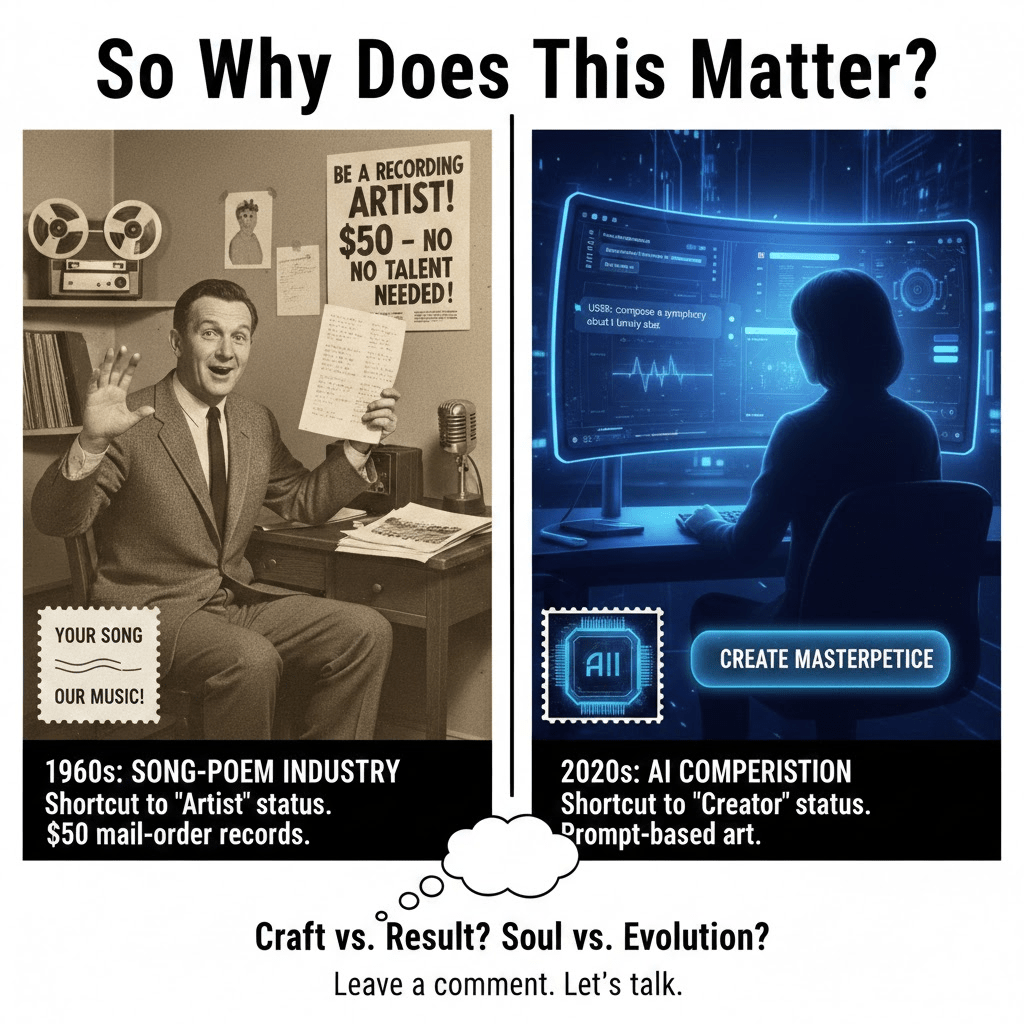
    AI misspelling “comparison” is GOLD!

    IIt matters because it proves that humans have always loved the shortcut. Let’s be honest: we are wired to take the easy way out. Historically, if you wanted to be a recording artist, you had to put in the “10,000 hours.” You had to learn an instrument, find a band that didn’t hate each other, and practice until your fingers bled.

    The Song-Poem industry changed the gatekeeping. It allowed people without a lick of musical talent, people who couldn’t carry a tune in a bucket, to bypass the hard work and jump straight to the “Artist” phase. For fifty bucks, you weren’t just a guy with a notepad; you were a “Recording Artist.”

    Does that sound familiar?

    It’s exactly what AI is doing right now. It is the ultimate democratization—or, depending on how cynical you’re feeling today, the ultimate dilution. AI lets us do things we aren’t actually qualified to do. You don’t need to understand color theory to “paint” a masterpiece, and you don’t need to know a C-major from a G-seventh to “compose” a symphony.

    We’ve traded the craft for the result. The interface has changed from a postage stamp to a chat window, but the ghost in the machine—that deep-seated desire to be “creative” without doing the heavy lifting—is exactly the same.

    What do you think? Is AI just the high-tech version of a $50 mail-order record? Are we losing the soul of the craft, or is this just the next logical step in musical evolution?

    Leave a comment. Let’s talk.


    The Playlist: Artifacts of Analog AI

    If you want to hear what this “Analog AI” sounded like, you need to dig into the archives. Some of it is genuinely catchy; most of it is a fever dream of mid-century clichés.


    1. A total of 66 different musicians played in the English post-punk band The Fall during its 40-year existence from 1976 until the death of frontman Mark E. Smith in 2018.
       
      Mark E. Smith was the only constant member throughout the band’s history. The lineup was famous for its frequent changes, leading Smith to once quip, “If it’s me and your granny on bongos, it’s The Fall”. About one-third of the members who joined the band played for less than a year.  ↩︎
  • Canadian songs about the wind*

    *this post is AI-generated.

    Canada’s vast landscapes—from the howling prairies to the Atlantic gales—have made “the wind” a constant muse for our independent and alternative artists. While legends like Ian Tyson and Neil Young popularized the theme with “Four Strong Winds,” the independent scene today offers some haunting and beautiful variations on the concept.

    At the same time, Canada’s independent music scene has a long history of using the wind as a central theme, capturing everything from the biting cold of the north to the restless energy of the prairies.

    Here are five songs about the wind by independent (or fiercely independent-leaning) Canadian artists:

    1. “East Wind” – Caley Watts

    Caley Watts is a Cree singer-songwriter from the Saddle Lake Cree Nation. This track is a masterclass in atmospheric folk-soul. It starts as a quiet, introspective piece and builds into a powerful storm of electric guitar, using the “East Wind” as a striking metaphor for emotional upheaval and personal change.

    2. “That Wind” – Jade Turner

    Hailing from Manitoba, Jade Turner is a celebrated Indigenous country-folk artist. In this track, she captures the essence of the Canadian Prairies, where the wind is a constant, almost sentient presence. It’s a song about listening to your roots and finding the strength to move forward when the “wind calls out your name.”

    3. “Wind Blows” – Yukon Blonde

    Originally from Kelowna, BC, Yukon Blonde represents the more “indie-rock” side of this list. This song captures a restless, West Coast energy. While it features their signature psych-pop harmonies, the lyrics deal with the isolation and the sound of the wind rattling against a window during a storm.

    4. “Cold Wind” – Arcade Fire

    Before they were headlining arenas, Arcade Fire released this haunting track for the Six Feet Under soundtrack. It perfectly encapsulates the “Montreal Sound” of the early 2000s—it’s sparse, eerie, and echoes the biting, whistling chill of a Canadian winter wind blowing through an empty street.

    5. “I Am the Wind” – Stompin’ Tom Connors

    Stompin’ Tom was the quintessential independent artist, famously avoiding major labels and corporate influence to tell Canadian stories his own way. This is one of his most poetic songs; rather than his usual upbeat anthems, this is a beautiful personification of the wind as it travels from the Rockies to the Maritimes.

  • What are some songs about the wind?

    Environment Canada issued a Severe Wind Alert for a large part of Ontario because of: “Strong southwesterly and northwesterly wind gusts of 70 to 90 km/h.” (For my American amigos reading this, that’s about 9 mph.)

    My friends’ daughter is decidedly NOT a fan of the wind, so I asked Gemini for a list of songs about the wind to take her mind off it.

    Gemini failed to include Windy by The Association in it’s list, so i’m starting to side with the AI haters: AI is all a big scam and the bubble is gonna burst any second now.

    On the other hand, Mr. Gemini reminded me of Nina Simone’s version of Wild is the Wind, so the bubble can live another day. For now.

    SPOILER ALERT: YouTube Playlist of Songs About the Wind created by Gemini available here.

    Here are some songs about the wind!

    The Philosophical Classics

    These songs use the wind to explore deep questions about life, mortality, and society.

    Songs about the wind often use it as a metaphor for change, the passage of time, or the intangible nature of human emotions. Depending on what you’re looking for, here are some of the most iconic and meaningful tracks categorized by their “vibe.”

    • Blowin’ in the Wind” by Bob Dylan (1963): Perhaps the most famous “wind” song. It poses a series of rhetorical questions about peace and freedom, concluding that the answers are as elusive as the wind itself.
    • Dust in the Wind” by Kansas (1977): A haunting acoustic meditation on the fleeting nature of human existence. The message is simple: everything we build eventually blows away.
    • Wind of Change” by Scorpions (1991): An iconic power ballad that became the unofficial anthem for the end of the Cold War and the fall of the Berlin Wall.

    Atmospheric & Romantic

    These tracks use the wind to set a specific mood, often one of longing or intense passion.

    • The Wind Cries Mary” by Jimi Hendrix (1967): Written after an argument with his girlfriend, this bluesy rock song uses the wind to reflect a sense of personal loneliness and quiet reflection.
    • Wild Is the Wind” by Nina Simone (1966) / David Bowie (1976): A deeply emotional song where the wind represents the wild, unpredictable force of love. Both versions are legendary for their vocal intensity.
    • Summer Wind” by Frank Sinatra (1965): A nostalgic classic that tells the story of a lost summer romance, with the wind serving as the narrator of the passing seasons.
    • Windy” by The Association (1967): A sunshine-pop classic that personifies the wind as a whimsical, free-spirited woman “tripping down the streets of the city.”

    BONUS: The Simpsons – Martin’s Pool Breaks, then Martin breaks into Summer Wind.

    Pop & Soft Rock Hits

    If you’re looking for high-energy or radio-friendly tracks, these are the staples.

    • Ride Like the Wind” by Christopher Cross (1980): A fast-paced yacht rock anthem about a man on the run, trying to reach the border before he’s caught.
      BONUS: Rick Moranis as Michael McDonald on SCTV singing Ride Like the Wind.
    • Candle in the Wind” by Elton John (1973/1997): Originally written for Marilyn Monroe, it uses the “candle in the wind” metaphor to describe a life that burned brightly but was extinguished too soon.
    • Wind Beneath My Wings” by Bette Midler (1988): A powerhouse ballad about gratitude and the unsung heroes who support others from the shadows.
    Temporary image to be blown away soon.

    Modern & Seasonal Picks

    More recent hits or songs that capture a specific time of year.

    • Wind Up Missin’ You” by Tucker Wetmore (2024): A recent country hit that uses the idea of “winding up” somewhere to describe falling into a relationship.
    • Winter Winds” by Mumford & Sons (2009): A high-energy folk-rock song that captures the brisk, changing feeling of the winter season and shifting perspectives.
    • Weren’t for the Wind” by Ella Langley (2025): A contemporary country track that reflects on how external forces—like the wind—can be the only thing keeping a person moving.

    CanCon wind songs!

    Canada’s vast landscapes—from the howling prairies to the Atlantic gales—have made “the wind” a constant muse for our independent and alternative artists. While legends like Ian Tyson and Neil Young popularized the theme with “Four Strong Winds,” the independent scene today offers some haunting and beautiful variations on the concept.

    Canada’s independent music scene has a long history of using the wind as a central theme, capturing everything from the biting cold of the north to the restless energy of the prairies.

    Here are five songs about the wind by independent (or fiercely independent-leaning) Canadian artists, now with links to listen:

    1. “East Wind” – Caley Watts

    Caley Watts is a Cree singer-songwriter from the Saddle Lake Cree Nation. This track is a masterclass in atmospheric folk-soul. It starts as a quiet, introspective piece and builds into a powerful storm of electric guitar, using the “East Wind” as a striking metaphor for emotional upheaval and personal change.

    2. “That Wind” – Jade Turner

    Hailing from Manitoba, Jade Turner is a celebrated Indigenous country-folk artist. In this track, she captures the essence of the Canadian Prairies, where the wind is a constant, almost sentient presence. It’s a song about listening to your roots and finding the strength to move forward when the “wind calls out your name.”

    3. “Wind Blows” – Yukon Blonde

    Originally from Kelowna, BC, Yukon Blonde represents the more “indie-rock” side of this list. This song captures a restless, West Coast energy. While it features their signature psych-pop harmonies, the lyrics deal with the isolation and the sound of the wind rattling against a window during a storm.

    4. “Cold Wind” – Arcade Fire

    Before they were headlining arenas, Arcade Fire released this haunting track for the Six Feet Under soundtrack. It perfectly encapsulates the “Montreal Sound” of the early 2000s—it’s sparse, eerie, and echoes the biting, whistling chill of a Canadian winter wind blowing through an empty street.

    5. “I Am the Wind” – Stompin’ Tom Connors

    Stompin’ Tom was the quintessential independent artist, famously avoiding major labels and corporate influence to tell Canadian stories his own way. This is one of his most poetic songs; rather than his usual upbeat anthems, this is a beautiful personification of the wind as it travels from the Rockies to the Maritimes.


    One last breath of fresh air:

  • Overwhelmed by good ideas generated by AI? Here’s how to cope

    AI has dramatically transformed a lot of things. One of them is brainstorming.

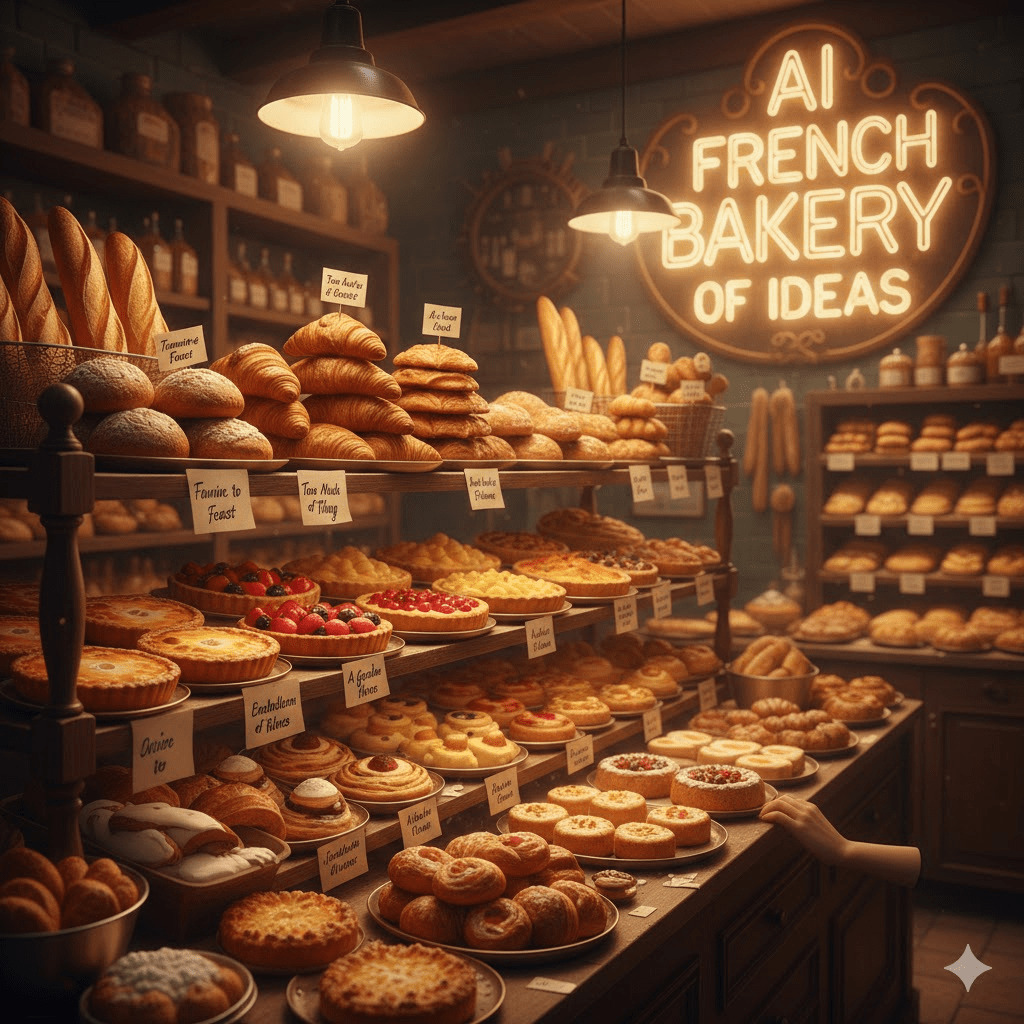
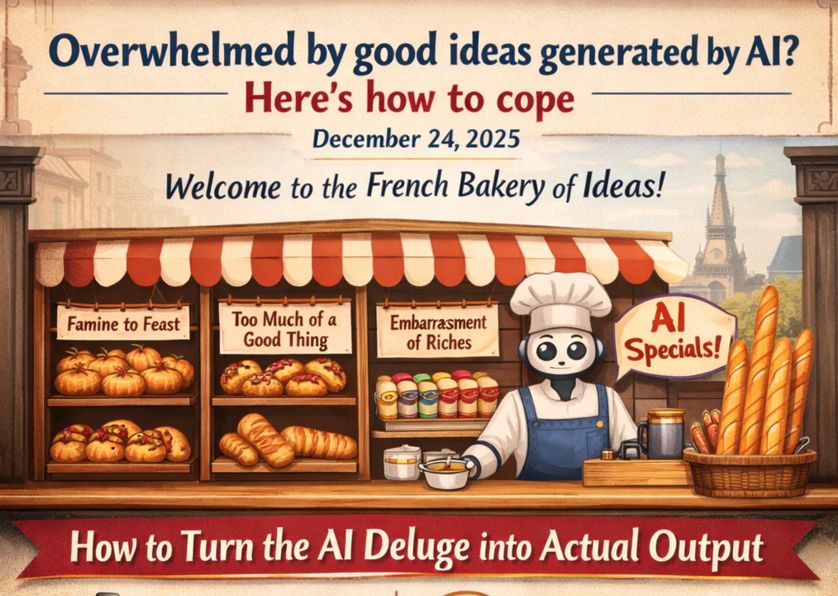
    In terms of generating ideas, we’ve gone from staring at an empty pantry for days on end to having a French bakery at our fingertips in the blink of an eye.

    Here’s how I imagine that AI bakery: One shelf has “famine to feast” éclairs. Next is “too much of a good thing” croissants. Then there is “an embarrassment of riches” macarons, and next to those treats are “a good problem to have” baguettes.  You name the cliché, and AI’s French Bakery of Ideas has it!

    The problem now is not generating good ideas but managing the overgrown garden of goodness. (I’m mixing my metaphors here – I better have AI clean up this copy – oh wait…)

    How we can navigate our way through the patisserie of AI-generated ideas?

    It takes discipline to choose the ideas to start working on when they all look so good. Wanting them all almost always means losing them all. Humans only have so much time and energy, so it kind of comes down to Sophie’s Choice – which of your children do you save, which ones do you sacrifice?

    I asked Google Gemini how to deal with an overabundance of good ideas, and I think the bot’s response is a good one. As anyone who uses AI knows, that isn’t always the case.

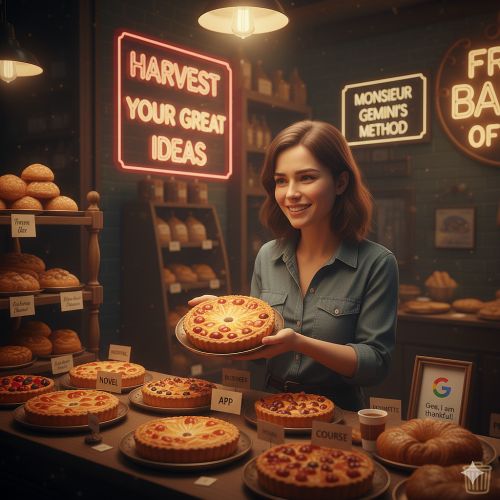
    So, refresh your coffee, grab another French pastry, and then take in this advice for dealing with too much of a good thing. Maybe grab a serviette too (serviette is French for napkin, Nadwuar fan), because this gameplan is so tasty it will make you salivate.

    I now give the floor to Monsieur Gemini.

    How to turn the AI deluge into actual output

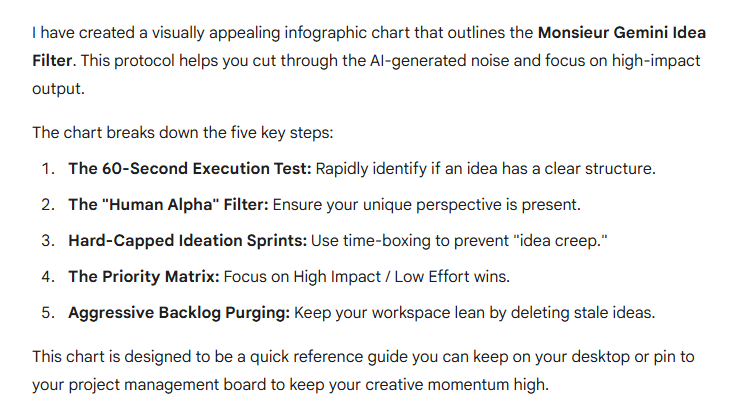
    If you don’t have a systematic way to kill off ideas, you aren’t a creator; you’re an archivist. To turn the AI deluge into actual output, you need a cold-blooded filtering process. Here is the protocol I use to maintain velocity:

    • The 60-Second Execution Test: Read the AI-generated prompt. If you can’t mentally outline the three main pillars of the piece within 60 seconds, discard it. If you have to “work” to find the angle, the idea isn’t sharp enough. Move on.
    • The “Human Alpha” Filter: Ask yourself: What can I add to this that the model can’t? If the idea is purely informational and lacks a perspective based on your specific experience or “boots-on-the-ground” data, it’s commodity content. Delete it.
    • Hard-Capped Ideation Sprints: Never leave an AI chat open while you write. Set a timer for 10 minutes to brainstorm. At the end of that 10 minutes, pick your lead and close the tab. Keeping the “Idea Engine” running while you are in “Execution Mode” is a recipe for a half-finished draft.
    • The Priority Matrix: Organize your selected ideas into a simple 2×2 grid. Prioritize High Impact / Low Effort first. If it doesn’t fit a specific strategic goal, it’s immediate trash.
    • Aggressive Backlog Purging: If an idea sits in your Notion or project board for more than 14 days without being touched, it’s dead. Purge it. If it were truly “killer,” it would have stayed at the front of your mind.

    Don’t let all your great ideas die on the vine. Pick the really good ones, make them great, and make 2026 a vintage year.


    *This post has been brought to you by the letter G, as in Gee, I am thankful for Google Gemini!

  • From APCs to Apple Bags Subtitle: Ziv’s New Mission on the Streets of Toronto

    Instead of driving APCs, he now drives a red grocery delivery truck. Instead of being on a mission to kill the enemy, he is now on a mission to feed his new friends. Instead of smelling sweat, death, and diesel, he now inhales the scent of celery, bread, and what is on sale this week.

    He now lugs heavy bags of groceries for senior citizens, people with physical disabilities, those he can’t drive, and anyone who can’t do it for themselves. It is “the same but different” as lugging 120mm Mortar Shells.

    Lately, he’s been feeling down, wondering if he made the right decision by moving to Canada. This morning, he is very much questioning his decision, because while out delivering groceries and running his butt off to meet his quotas and avoid getting fired, he has to struggle through 8 inches of wet, heavy snow that fell overnight.

    The temperature is above freezing, so big chunks of snow are falling off trees and hitting him while he runs up to the doors with groceries. The Canadian snow bombs remind him of Russian “incoming”. Many walkways haven’t been cleared yet, and roadways are a sloppy mess.

    He’s feeling really down and worried when one customer calls him back to their house after he’s dropped off groceries. He thinks he is about to get yelled at.

    “Ziv!” the customer calls out. The crippled old man knows that the grocery guy is named Ziv because that’s the name he’s seen on the app every time he has ordered groceries over the last year.

    Ziv returns to the door meekly, expecting the worst.

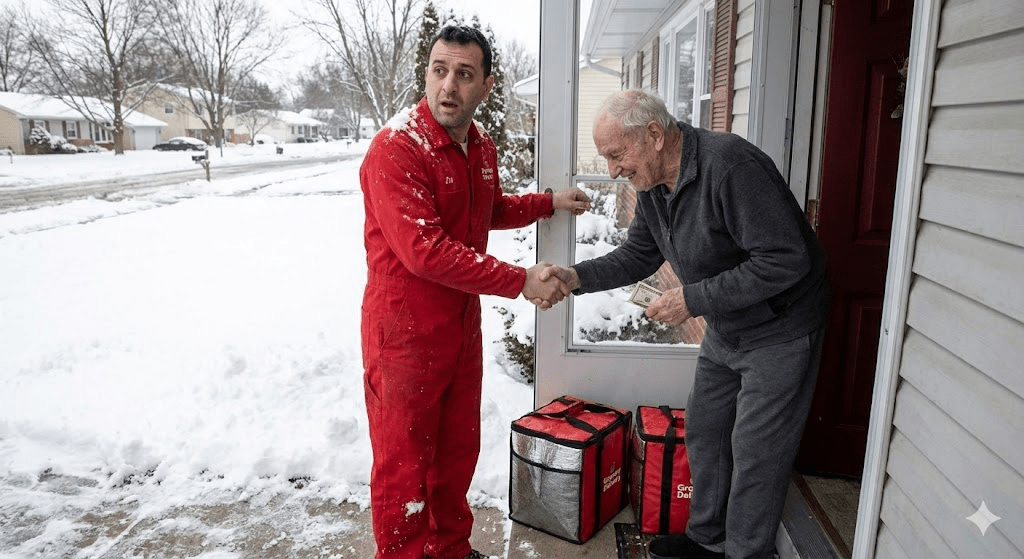
    Instead, the hunched over geezer holds out his hand, a $20 about to move from it to Ziv’s.

    “I appreciate all your efforts.”

    Ziv smiles, and the two people shake hands. Suddenly he was happy to be in The Great White North, a place where palms are greased, not tank tracks.

    “Merry Christmas, Happy New Year.”

    Ziv – a man who knows the importance of transferable skills.

  • I think there ought to be “Grandma Lanes”.

    Every year I hear about another Grandma getting run over by a reindeer.

    If Grandmas had their own lanes, instances of them getting run over by a reindeer would fall dramatically.

  • From Springsteen’s Nebraska to North Carolina: Music, Murder, and a Chicken Plant Disaster

    After 40 years of hype, a movie, and a multi-disc reissue, I finally gave in and listened to Bruce Springsteen’s critically acclaimed and fan-revered album Nebraska.

    Nebraska is a pretty good album, but it didn’t blow me away or make me think, “This is the greatest thing ever.” My reaction is similar to how I feel about Amy Winehouse’s music: it is OK, but not earth-shattering. Both artists’ work feels more like a nod to earlier genres than a groundbreaking revolution.

    Jello and Mojo must have been Springsteen fans

    What DID strike me is that Jello Biafra and Mojo Nixon used the tune of the title track from Nebraska for their song “Hamlet Chicken Plant Disaster,” which appears on the fine album Prairie Home Invasion.

    Nebraska isn’t Springsteen’s biggest album. It isn’t as massive as Born in the USA or Born to Run, albums you know whether you want to or not. Nebraska had no singles, Bruce didn’t tour or do promotion for it, and it doesn’t get airplay, so you have to be a fan and seek it out if you want to hear Nebraska. It surprises me that Jello and/or Mojo would do that on some levels, but then again, it doesn’t surprise me at all.

    I grabbed Prairie Home Invasion when it first came out in 1994. I loved it immediately and continue to give it a spin every once in a while. In other words, I already knew Hamlet Chicken Plant Disaster well.

    So when I was listening to the song Nebraska for the first time, I thought, “Is that that Prairie Home Invasion song?” I wondered if it was a traditional song that both Bruce and Jello/Mojo interpreted independently of each other. It isn’t, and it wasn’t, of course. All songs on Nebraska are Bruce originals.

    Jello and Mojo put different words on the Springsteen tune, giving the song a modern feel with an anti-corporate greed stance. I mean, we ARE talking Jello Biafra and Mojo Nixon here!

    The origins of Springsteen’s song Nebraska

    Springsteen’s song is written from the perspective of Charles Starkweather, a person who killed 10 people between 1957 and 1958.  Starkweather showed no remorse, not even when strapped to the electric chair.

    Apparently, Bruce wrote the song Nebraska after watching the 1973 movie Badlands and reading the Ninette Beaver book Caril, a book about Caril Ann Fugate, Starkweather’s teenage girlfriend and accomplice. Fugate served 18 years after being tried and convicted of first-degree murder.

    The origins of the song Hamlet Chicken Plant Disaster

    Jello and Mojo’s lyrics, by contrast, recount the 1991 Hamlet, North Carolina, chicken processing plant fire, a tragedy where 25 workers died, 49 children were orphaned, and many more suffered lasting trauma.

    The Hamlet chicken processing plant, owned by Emmett Roe, had its emergency exits and other doors locked to prevent employee theft. When the fire broke out, workers were trapped inside, unable to escape the smoke and flames. Twenty-five lives were lost—all due to efforts to prevent the theft of dead chickens.

    Charles Starkweather (Nebraska) vs. Emmett Roe (North Carolina):

    • Charles Starkweather killed 10 people and was cooked like a chicken by the State.
    • Emmett Roe pretty much killed 25 people by protecting dead chickens from theft. He received 4 years free room and board courtesy of the State.

    Bruce Springsteen vs. Mojo Nixon and Jello Biafra:

    • Springsteen released Nebraska to critical acclaim in 1982. It has sold over 4 million copies and was recently turned into a movie starring the guy from The Bear.
    • Jello and Mojo released Prairie Home Invasion on Alternative Tentacles in 1994, and it currently sells for anywhere from five to twenty-five bucks.  

    Two men were judged. Now you can judge two songs:

    (Jello and Mojo get more real estate because they are a complete band, and Bruce is “just” Bruce.)

  • X (Twitter) is to communication what McDonald’s is to nutrition”

    This article will draw parallels between the fast, convenient, and mass-produced nature of both Twitter and McDonald’s, while also highlighting their addictive qualities and potential drawbacks.

    Just as McDonald’s offers quick, easy, and widely accessible meals that are often high in calories but low in nutritional value, Twitter provides a platform for rapid, bite-sized communication instantly available to millions. Both appeal to our desire for speed and convenience: McDonald’s serves food in minutes, and Twitter lets users share thoughts or consume information in seconds.

    The more junk food or tweets we consume, the more we crave

    A key similarity is their addictive nature. McDonald’s food is engineered to be crave-worthy. It is salty, sweet, and fatty in just the right amounts to keep people coming back for more. And more. Similarly, Twitter’s design taps into psychological triggers: notifications, likes, retweets, and an endless scroll of new content create a feedback loop that encourages frequent, sometimes compulsive, engagement. In both cases, the more we consume, the harder it can be to stop, even if we’re aware that overindulgence may not be good for us.

    They call McDonald’s junk food and twitter toxic for a reason

    This analogy also highlights their limitations. While McDonald’s can satisfy immediate hunger, it rarely provides the nourishment of a balanced meal. In the same way, Twitter’s 280-character limit encourages brevity over depth, making nuanced or meaningful conversations challenging. The platform often favors sensationalism, quick takes, and viral moments, just as fast food prioritizes taste and accessibility over health.

    In essence, both Twitter and McDonald’s are products of a culture that prizes speed and efficiency, sometimes at the expense of substance and quality. While they serve a purpose and can be enjoyable in moderation, their highly addictive nature means that relying on them exclusively may ultimately leave us wanting more—be it more nutrition or more meaningful communication.

  • Why Are LinkedIn Posts All the Same?

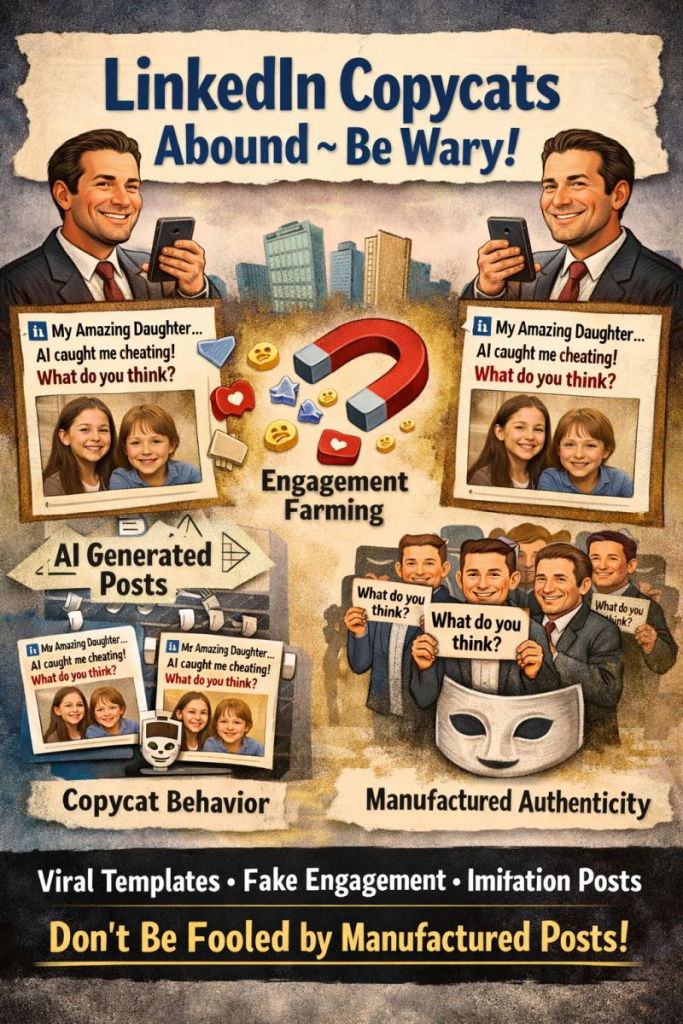
    Q: i saw two very similar posts on LinkedIn today. Both took a long talk talking about how wonderful their daughter is. Then they said that AI caught them cheating, and asked What do you think? at the end.

    What is going on?

    1. 1. Viral Post Templates:
    2. 2. Engagement Farming:
    3. 3. Copycat Behavior:
    4. 4. Manufactured Authenticity:
    5. In summary:
    6. How can we guard against this type of manipulative behaviour?

    AI: What you’re describing is a trend on LinkedIn—and increasingly on other social platforms—where posts follow a specific viral formula designed to maximize engagement.

    Here’s what’s likely happening:

    1. Viral Post Templates:

    Some users copy successful post formats almost word-for-word, simply swapping out names or details. These templates often combine emotional storytelling (e.g., praising a child) with a surprising twist (e.g., “AI caught them cheating”) and then end with a call-to-action like “What do you think?”

    2. Engagement Farming:

    The goal is to provoke reactions, comments, and shares. By mixing personal stories with hot topics (like AI), and ending with an open-ended question, the post is engineered to encourage interaction and boost visibility in LinkedIn’s algorithm.

    3. Copycat Behavior:


    When one post goes viral, others quickly imitate it to try to get similar attention. Sometimes, people even use AI tools to generate these posts, leading to eerily similar content appearing across multiple profiles.

    4. Manufactured Authenticity:


    LinkedIn’s culture rewards posts that seem authentic and emotionally resonant, but when overused or obviously copied, these formulas feel artificial or manipulative, adding to the perception of “toxicity.”

    In summary:


    You’re witnessing a combination of viral content templates, engagement tactics, and copycat behavior. This is why you’re seeing almost identical posts, even on something as personal as celebrating a family member. It’s a reflection of how social media algorithms and attention-seeking strategies shape the content people share.

    How can we guard against this type of manipulative behaviour?

    Guarding against manipulative behavior like viral content templates and engagement farming on platforms like LinkedIn involves a mix of personal strategies and wider community awareness:

    1. Cultivate Media Literacy:
    Be critical of emotional or “too perfect” stories, especially when they follow a formula. Ask yourself: does this post feel authentic, or does it seem designed to provoke a reaction?

    2. Don’t Reward Manipulation:
    Avoid liking, sharing, or commenting on posts that feel manipulative or inauthentic. Engagement is the currency of social platforms—without it, such posts lose visibility.

    3. Seek Substance Over Style:
    Focus on and interact with posts that offer genuine insight, constructive advice, or meaningful discussion, rather than those fishing for engagement.

    4. Curate Your Network:
    Be selective about who you connect with and follow. If certain connections consistently share manipulative content, consider unfollowing or muting them.

    5. Report Spam and Misuse:
    Most platforms, including LinkedIn, have reporting mechanisms for spam or inauthentic content. Use these tools when you see clear cases of manipulation.

    6. Lead by Example:
    Share original, thoughtful content yourself. Others are more likely to follow suit if they see authentic voices in their feeds.

    7. Raise Awareness:
    Discuss these patterns with your own network—sometimes, people don’t realize they’re engaging with or amplifying manipulative posts.

    Ultimately, while we can’t control what others post, we can shape our own experience and contribute to a healthier online environment by being mindful, discerning, and intentional in our interactions.

  • The Proto-AI of William S. Burroughs: Cut-Ups, Shotguns, and the Algorithm of Chance

    William S. Burroughs, the counter-culture literary icon and author of Naked Lunch, often seems a figure of the past. Yet, his radical artistic methods—specifically the cut-up technique and his shotgun paintings—reveal a surprising, almost prophetic, engagement with concepts that now define the era of Artificial Intelligence (AI) and Large Language Models (LLMs).

    Burroughs’s work, conducted decades before the first publicly available consumer AI, can be viewed as an attempt to find an algorithm for creativity and to remove the human element from artistic production, mirroring core debates surrounding today’s generative AI.

    1. I. The Cut-Up Method: A Primitive LLM
    2. II. David Bowie’s Verbasizer: The First LLM on a Laptop
    3. III. Generative Chaos: Removing the Human Hand
      1. A. The Shotgun Paintings
      2. B. MythBusters and the “Painting with Explosives” Test
    4. Conclusion

    I. The Cut-Up Method: A Primitive LLM

    Burroughs, along with collaborator Brion Gysin, pioneered the cut-up method: physically cutting up existing texts (newspapers, novels, speeches) and rearranging the pieces into a new, fractured, and often deeply unsettling narrative.

    This process is strikingly similar to how modern LLMs like ChatGPT and Gemini function.

    • The LLM Analogy: An LLM does not think or create from a void; it processes a massive corpus of existing literature, code, and information. When prompted, it rearranges and probabilistically selects the most likely next word, generating a coherent-seeming, but fundamentally derivative, output.
    • The Burroughs Protocol: Burroughs’s cut-ups rearranged existing literature into something new by randomizing the sequence of pre-existing linguistic units (sentences and phrases). This act of recombination and randomization fundamentally parallels the stochastic text generation employed by today’s models. It is an act of recombinant literature, using the source text as a dataset to generate “new” meaning through algorithmic chance, much like a primitive, analogue language model.

    II. David Bowie’s Verbasizer: The First LLM on a Laptop

    The conceptual leap from the analog cut-up method to modern LLMs was bridged by David Bowie, a longtime admirer of Burroughs, who brought the process into the digital age in the 1990s.

    • The Transition to Software: Working with programmer Ty Roberts, Bowie co-created a Macintosh application called the Verbasizer. This custom software automated Burroughs’s process: the artist would input his own writings and other texts, and the Verbasizer would mechanically cut the sentences into phrases and then randomly reorder them.
    • A True Proto-LLM: This process moved beyond the physical randomness of paper scraps to a digital, algorithmic randomization, creating a “real kaleidoscope of meanings” for lyrics on albums like Outside (1995). The Verbasizer was a dedicated text-generation program designed explicitly to break writer’s block and introduce unpredictable linguistic novelty—a direct ancestor of how writers use modern AI to generate text prompts.

    III. Generative Chaos: Removing the Human Hand

    The concept of removing the human element from artistic composition, initiated by Burroughs’s shotgun art, found both a high-art example and a spectacular pop-culture echo.

    A. The Shotgun Paintings

    Towards the end of his life, Burroughs created abstract expressionist paintings by firing a shotgun at cans of paint placed in front of a plywood canvas. The resulting splatter and chaotic patterns became the final artwork.

    • The Dehumanized Artist: By using a weapon and the random force of an explosion, Burroughs outsourced the compositional decision-making to a non-human, mechanical force. The artist’s role shifted from creator to curator—he set the parameters (the paint, the canvas, the gun) and allowed the algorithm of physics and chance to execute the final piece. The shotgun acted as his generative algorithm.

    B. MythBusters and the “Painting with Explosives” Test

    The MythBusters episode “Painting with Explosives; Bifurcated Boat” (2013) provides a fascinating, high-octane echo of Burroughs’s method.

    • The Algorithm of the Boom: Jamie Hyneman and Adam Savage tested whether one could successfully paint a room using explosives and paint. The goal resulted in pure chaotic, generative abstract art.
    • The High-Energy Algorithm: Like Burroughs’s shotgun blast, the explosives completely removed intentional brushwork. The “art” was the product of chemistry, physics, and explosive force—a high-energy, real-world generative algorithm. The hosts became mere engineers setting the parameters for a non-human process to create an unpredictable, visually striking outcome.

    Conclusion

    Burroughs’s experiments were not merely artistic gimmicks; they were profound attempts to explore the limits of language and authorship. By embracing the algorithm of chance, whether through the rearrangement of words or the physics of a bullet, he laid the conceptual groundwork for a future where creativity is increasingly mediated and shaped by non-human intelligence, connecting the literary underground of the 20th century directly to the AI labs of the 21st.