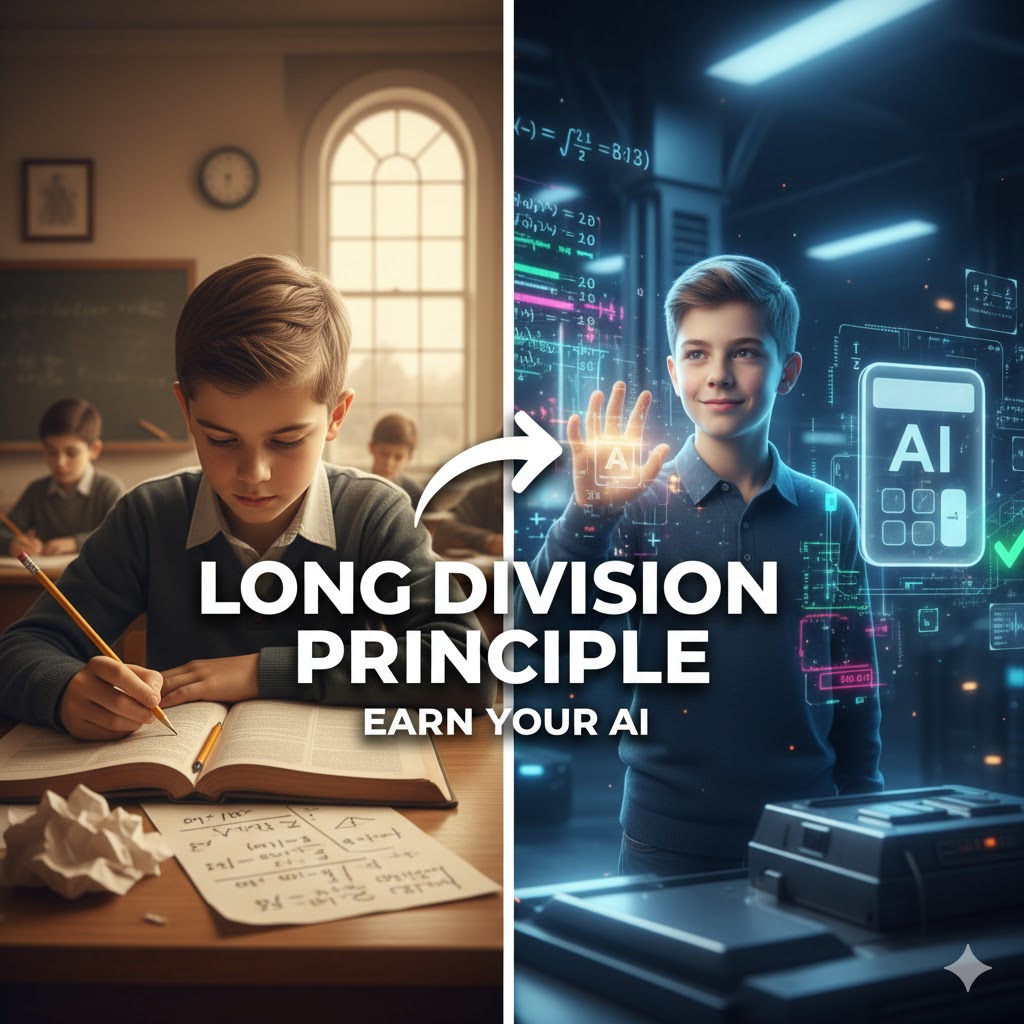
📐 The Long Division Principle: Why AI Must Be a Graduation, Not a Shortcut
In the rush to integrate Artificial Intelligence into every facet of our lives, especially education, we risk losing sight of a foundational truth—what I call The Long Division Principle.
The principle is simple: You teach a kid long division before you give them a calculator.
The Purpose of the Struggle
Think back to those early math classes. The process of long division is often cumbersome. It’s a series of multi-step operations that demand careful attention, iterative checking, and a deep understanding of place value. In short, it’s a struggle.
The modern calculator, or any basic spreadsheet function, makes this struggle instantly obsolete. So, why do we still force students through it?
The answer is that the goal of the lesson isn’t the final number; it’s the process.
| Manual Process (Long Division) | Calculator (AI) |
| Builds: Mental scaffolding, number sense, logical sequencing, patience. | Provides: Speed, accuracy, scale. |
| Teaches: How the math works and why the answer is correct. | Completes: The task instantly. |
| Produces: The critical thinker and discerning mind. | Produces: The efficient output. |
If a student is handed a calculator from day one, they achieve a correct answer, but they have no innate sense of whether that answer is reasonable. If they type $2 + $2 and the calculator says $5, they might accept it. They lack the intrinsic feel for the numbers that the manual struggle imparts.
AI and the Crisis of Discernment
This dynamic translates perfectly into the age of Generative AI. When we ask a Large Language Model to draft an essay, outline a marketing strategy, or summarize complex history, the AI is performing “long division” instantly.
For those of us who came up the hard way—the pre-AI generation—we know what the raw effort of research, analysis, and writing feels like. When an AI presents us with a flawless, coherent output, our brain instantly runs a few checks:
- Plausibility Check: Does this sound right? I spent two hours researching this topic; I know the common pitfalls.
- Structural Check: Is the argument logical? I remember the pain of revising my own shaky outlines.
- BS Check: Are the sources or facts solid? I know where a general knowledge model is likely to hallucinate because I had to hunt for those obscure facts myself.
Our prior struggle is our filter. It allows us to use AI as an amplifier, not a crutch. We are capable of discerning fact from elegant fiction because we learned to discern when we were the source of the effort.
The Educational Imperative
The educational challenge of the 2020s is ensuring that the next generation still develops this crucial filter. If students rely on AI to generate their work before they have internalized the standards of quality, research ethics, and logical reasoning, they become masters of output without an internal compass of truth.
The Long Division Principle dictates a phased approach to AI integration:
- Phase 1: The Scaffolding (Manual Effort): Teach the fundamentals—research methodology, analytical writing, basic coding logic, and mathematical principles—without the AI. Force the manual labor to build the necessary intellectual scaffolding.
- Phase 2: The Amplifier (AI Integration): Once the core skills are mastered, introduce AI as a tool for speed, scale, and iteration. The student now uses the AI to complete tasks faster and to check their own critical analysis against the machine’s output.
We must ensure that AI remains a graduation from the fundamental labor of learning, not a premature shortcut that bypasses the mental formation entirely. The ability to distinguish a good result from a plausible one is arguably the most critical skill in the AI age, and it is a skill earned, not downloaded.
What Do You Think?
We, the pre-AI generation, earned our right to use this incredible tool by putting in the hours. But what about the next generation?
Do you believe schools are adequately teaching the “long division” required for students to truly master AI, or are we setting them up for a crisis of discernment?
Join the conversation in the comments below, or share this post with an educator and ask:
Did your students earn their AI?
 Perry's Pen
Leave a comment