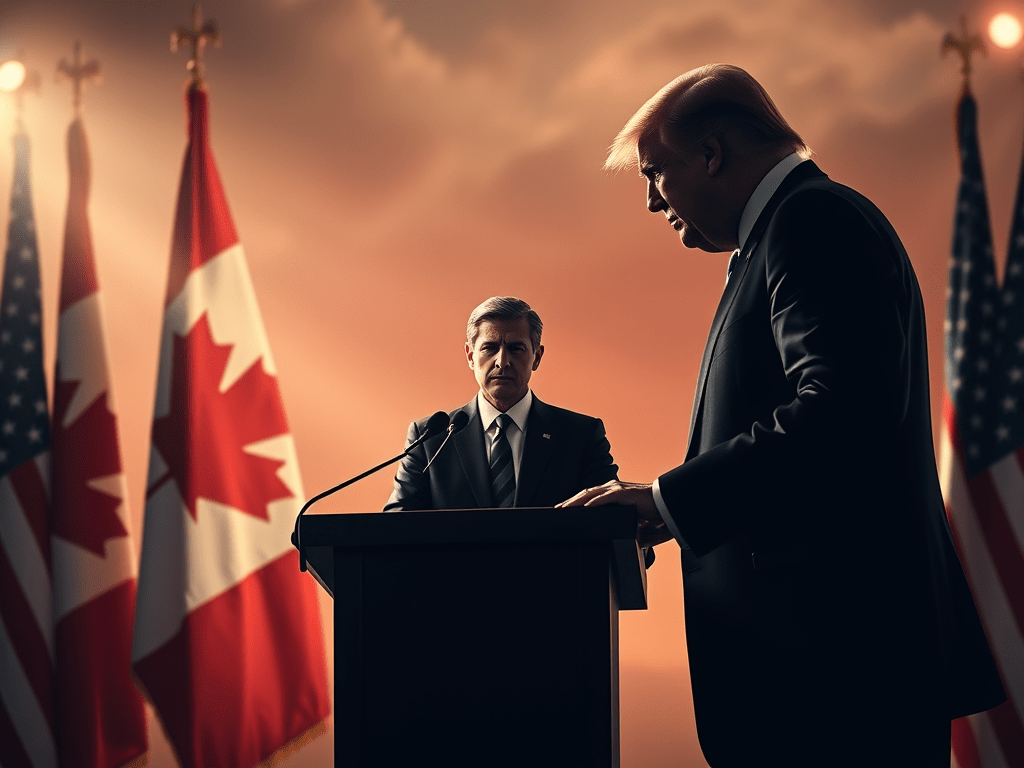
In this article, I will explore how Mark Carney’s tenure as Prime Minister has been shaped not by the economic discipline he once championed, but by a series of costly concessions to American demands. Rather than delivering the clinical precision of a central banker, Carney’s approach has often resembled a pattern of reactive, high-priced compromises—especially when confronted with President Trump’s hardball tactics. The following analysis examines how this so-called “pragmatism” has left Canada footing the bill for policies defined by someone else’s priorities.
- The $1.3 Billion Border “Gift.”
- NATO: From “Crass Calculation” to 5% GDP
- The Greenland Consulate: Outsourcing Arctic Security?
- The Bridge to Nowhere: Paying for the Privilege to be Robbed?
- The $100 Fire Sale: Joly’s “Good News.”
- Conclusion: The Carney Liquidation Sale
The $1.3 Billion Border “Gift.”
When President Trump claimed that fentanyl was “invading” the U.S. via the northern border—despite data often suggesting otherwise—Carney didn’t push back with facts; he pushed back with a chequebook.
- The Action: Carney allocated $1.3 billion (CAD) to “harden” the world’s longest undefended border. (Government of Canada expands plan to strengthen border security, 2025)
- The Critique: By spending a billion dollars to solve a problem Trump defined, Carney effectively validated a false narrative. For a prime minister who prides himself on data, spending billions on “optics” to appease a neighbour’s tweet is a stark departure from evidence-based policy.
NATO: From “Crass Calculation” to 5% GDP
For years, Canada resisted the 2% NATO spending target. However, after Trump threatened to leave the alliance—or worse, suggested the U.S. might not defend “delinquent” nations—Carney didn’t just meet the target; he blew past it.
- The Action: Carney accelerated the timeline to reach 2% by 2030 and, in a shocking move last August, pledged to aim for 5% by 2035 to match Trump’s new demands. (Canada commits to new NATO defence spending pledge to hit 5% of GDP by 2035, 2025)
- The Critique: Critics call this “security by subscription.” Rather than a sovereign defence strategy, it looks like a protection fee paid to Washington to keep the umbrella open.
The Greenland Consulate: Outsourcing Arctic Security?
Perhaps the most bizarre chapter has been the “Greenland Crisis.” When President Trump reignited his desire to annex the territory, the world largely scoffed—but the Carney government opened a consulate in Nuuk in February 2026. (Canada opens consulate in Greenland’s Nuuk, deepening Arctic ties, 2026)
- The Action: In the wake of U.S. threats to “buy” or “protect” Greenland from Russian and Chinese encroachment, Canada formally established a diplomatic and strategic foothold on the island. (Canada and France open consulates in Greenland following tensions over US push for control, 2026)
- The Original Critique: This looks like a desperate, reactive attempt to plant a flag before the U.S. can. It suggests Carney is governed by Trump’s whims rather than a long-term Canadian Arctic strategy.
- The “Outsourcing” Twist: Looking deeper, this move may be exactly what Trump wanted. By pressuring Canada into Greenland, Trump has successfully outsourced the cost of “defending” the North.
- The Result: Canada is now spending its own diplomatic and military capital to secure a territory that serves as a buffer for the United States. (International Security – Canada.ca, 2024) In Carney’s attempt to “save” Greenland from annexation, he has arguably turned Canada into the U.S.’s unpaid security guard in the Arctic, saving Washington billions while the Canadian taxpayer picks up the tab for “stability.”
The Bridge to Nowhere: Paying for the Privilege to be Robbed?
The latest and most audacious demand came this week, February 2026. President Trump threatened to block the opening of the $6.4 billion Gordie Howe International Bridge unless the U.S. is “fully compensated” and given 50% ownership. (Trump threatens to block opening of Gordie Howe International Bridge between Detroit and Canada, 2026)
- The Reality: Canada has paid for the entire bridge. Every cent. The 2012 agreement specifically states Canada will recoup its costs through tolls. (U.S.-Canada bridge brouhaha deepens as White House says Trump could amend a permit for the project, 2026)
- The “Hockey” Absurdity: To justify his “economic sabotage,” Trump posted a bizarre rant on Truth Social claiming that Carney’s trade talks with Beijing would lead to China “terminating all ice hockey in Canada” and “permanently eliminating the Stanley Cup.” * The Carney Response: True to form, Prime Minister Carney emerged from a “positive” call with Trump on Tuesday. Instead of calling out the lunacy of the “hockey ban” or the illegality of seizing a Canadian asset, Carney politely “explained” to Trump that Canada paid for the bridge.
- The Critique: Carney is treating a shakedown like a seminar. By saying the “situation will be resolved” through further negotiation, he has already signalled that Canada’s $6.4 billion investment is up for debate. If the “result” is Canada handing over half of its own bridge to stop Trump from tweeting about the Stanley Cup, then Carney isn’t a statesman—he’s a victim of a very expensive prank.
The $100 Fire Sale: Joly’s “Good News.”
If you want to know how the Carney government values Canadian tax dollars, look no further than the recent collapse of the Stellantis partnership. After billions in federal and provincial subsidies were committed to building a “battery powerhouse” in Windsor, Stellantis walked away from its 49% stake in the NextStar plant last week. (LG Energy Solution to Acquire Full Ownership of NextStar Energy in Joint Strategic Decision with Stellantis, 2026)
- The Price Tag: Stellantis sold its share—which represented nearly $1 billion in initial investment—to its partner, LG, for a “nominal fee” of just $100. (Bickis, 2026)
- The Joly Spin: Industry Minister Mélanie Joly didn’t express outrage. Instead, she stood before cameras and called the sale “really good news” because it shows LG is “here for the long run.”
- The Reality Check: Stellantis is fleeing the Canadian market to focus on U.S. production, likely spooked by Trump’s tariff threats. They just traded a billion-dollar Canadian asset for the price of a mid-range steak dinner. (Stellantis temporarily halts production at 2 plants in Canada, Mexico as auto tariffs take effect, 2025)
- The Critique: In the Carney world, losing a major global automaker and a billion-dollar stake is a “win” as long as you can spin it as “stability.” It’s the ultimate liquidation sale: we pay for the factory, the companies leave for the U.S. to appease Trump, and our ministers tell us we should be grateful they left the lights on for the next guy.
Conclusion: The Carney Liquidation Sale
Mark Carney asked to be judged by results. The results are now undeniable. Under his watch, Canada has become a discount outlet for American interests:
- We’re “buying” security by handing over 5% of our GDP to NATO.
- We’re “buying” peace by spending $1.3 billion on a border wall that Trump demanded.
- We’re “buying” influence by setting up a consulate in Greenland to do Washington’s dirty work.
- We’re “selling” our sovereignty by letting Trump hold the Gordie Howe Bridge hostage over a “hockey” tweet.
- We’re “selling” our industry for $100 while Mélanie Joly smiles and calls it a victory.
Mark Carney is managing Canada like a bank in receivership—liquidating assets, paying off the biggest creditors first, and hoping no one notices the “Going Out of Business” sign on the front door. If these are the “results” he wanted to be judged by, the verdict is in: Canada is being sold off, one “positive conversation” at a time.

 Perry's Pen
Leave a comment