• Dick Valentine brought live music back. Better.

    Everybody talks about missing sports and live music, but nobody does anything about it.

    Nobody, that is, except people like Dick Valentine. While artists, audiences, patrons, and even critics haven’t really done much about missing a few of our favorite things, Dick Valentine and his band Electric Six have kept busy in the brave new world of live streaming events.

    To date, Electric Six has done a few live shows without an audience and streamed them online. Dick Valentine has done over 50 solo shows via StageIt. His shows have varied in length, often been topical, and always a lot of fun.

    Dick Valentine’s StageIt shows are FUN!

    One of the fun things about StageIt shows is that they are never recorded and always live. There’s no sharing or watching later, so you gotta be there. It all adds to the excitement and fun, and there are a lot of “you shoulda been there!” moments.

    When you attend a StageIt show, there is a window where you can clap and sing and chat with your friends, which also helps to give the feel of a live show. All of the audience participation is silent, so have no fear you strong, silent types.

    Valentine, an accomplished acoustic troubadour and author, puts on shows that are just him and a guitar. There are no smoke machines, no spandex, and no legalized dope of any strain. What you do in the privacy of your own home remains your business, (at least for now), but two good things to do at home are watch March Madness and watch March Madness!

    March Madness + Music = Bliss!

    Valentine’s latest project on StageIt is a marriage made in heaven. In what is surely the greatest eureka moment anyone has had thus far in 2021, Dick has been playing live shows that pit his songs against each other.

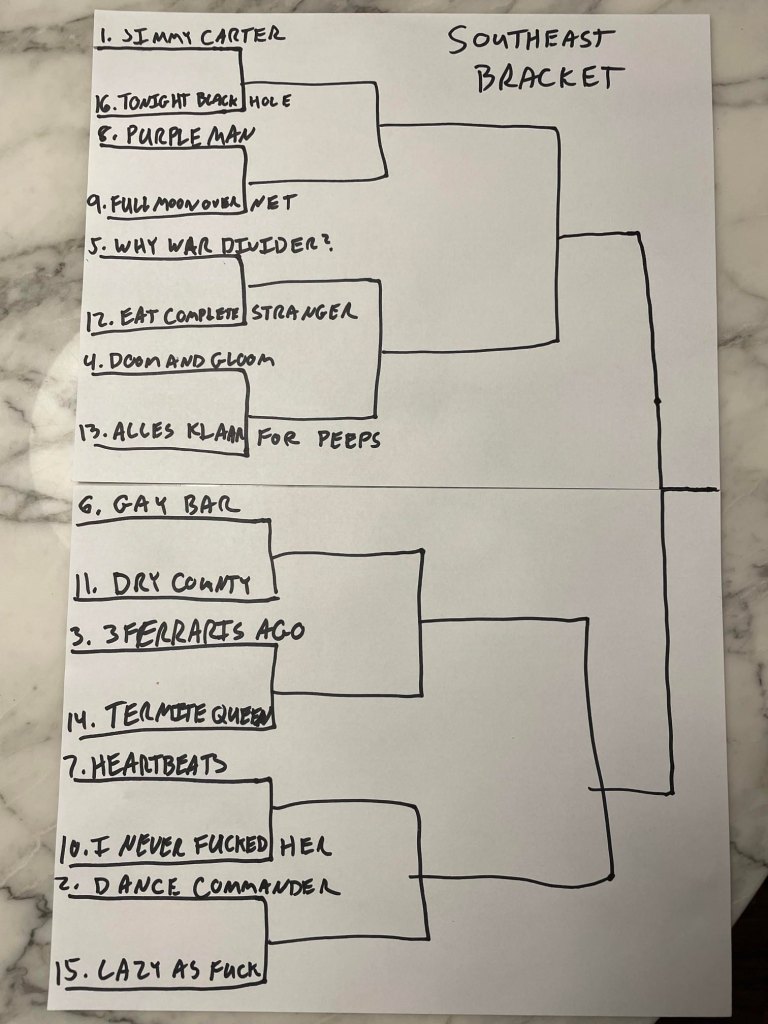
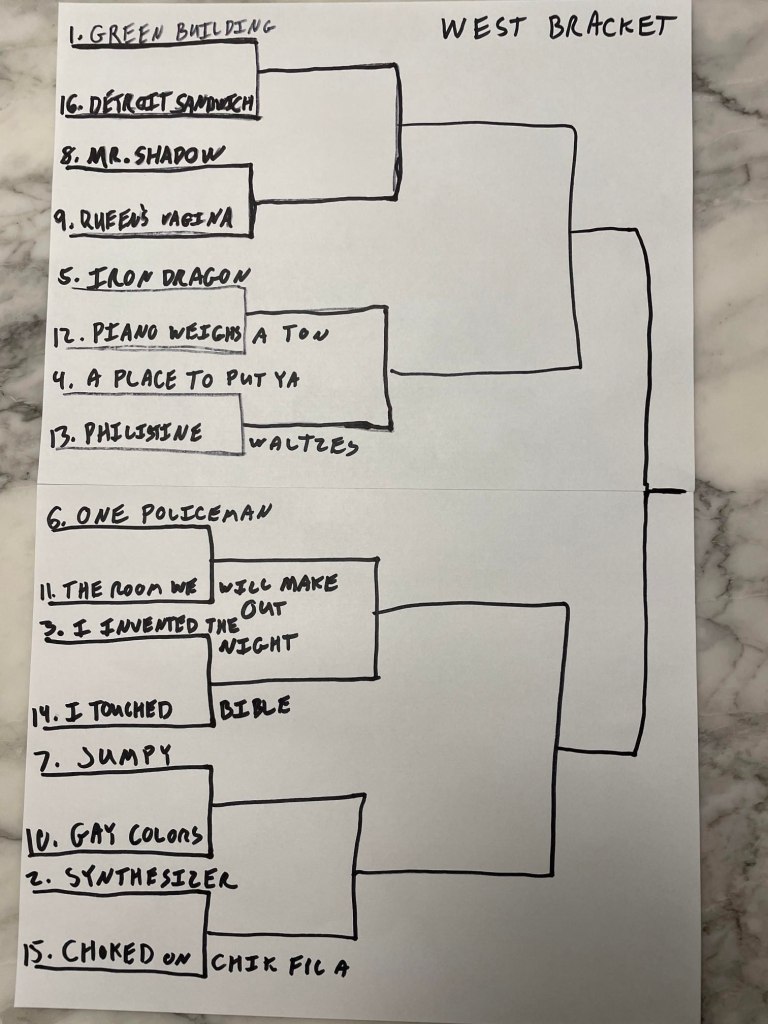
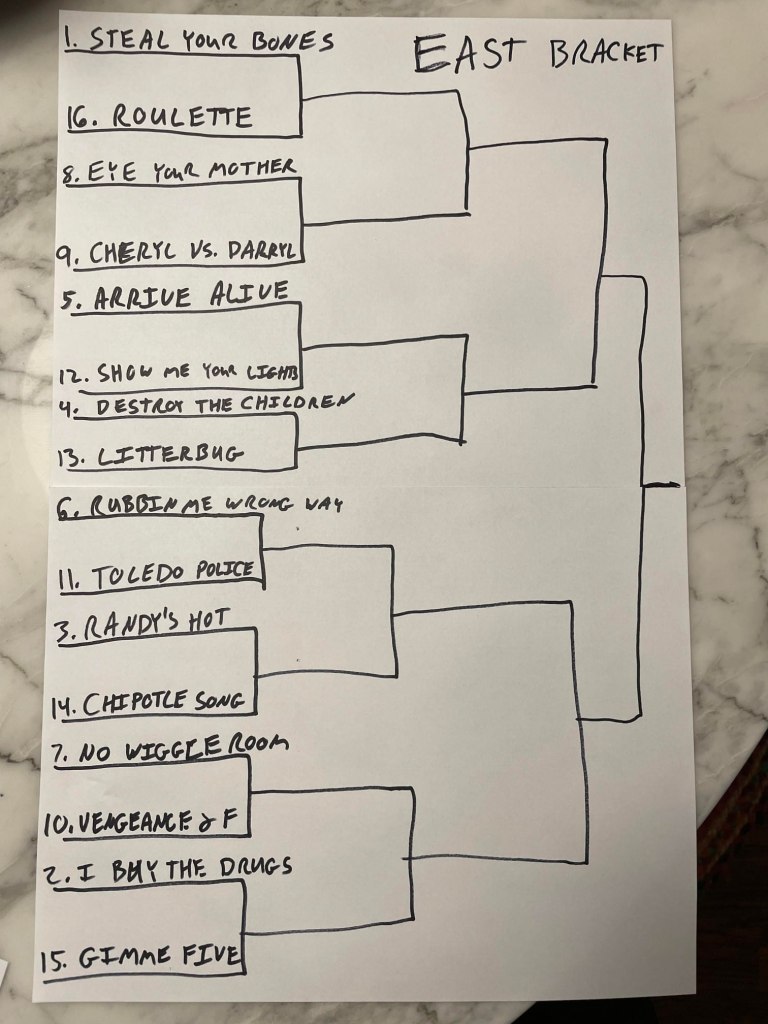
    It’s done in tournament style, with 64 of his songs entering his version of the hugely popular NCAA’s March Madness. There’s a bracket, of course, and all songs are seeded.


    Instead of basketball games being played, songs are voted on by people who attend Dick Valentine’s StageIt shows. The song with the most votes moves on, and the “loser” is put back into Valentine’s mind, or wherever maestro Dick keeps his masterpieces.

    Here’s the lineup from a recent day of competition:

    1. Jimmy Carter vs. 8. Arrive Alive
    4. Alone w/Your Body vs. 5. Vengeance and Fashion
    3. Why You Waging War on Me, Divider? vs. 11. Skin Caboose
    2. Destroy the Children vs. 7. The Band in Hell

    It’s still rather early in the tournament as I write this, but so far there have already “games” so close that “overtimes” have been needed to determine which song moves on. the excitement is there, the excitement is palpable, and it the excitement building.

    Get up off of that thing, dance and you’ll feel better

    How Dick Valentine has chosen to deal with the lockdown and his livelihood being threatened is to be applauded and duplicated. It also reminds me of some wonderful old Paul Weller lyrics:

    You don’t have to take this crap
    You don’t have to sit back and relax
    You can actually try changing it

    Just one more thing

    So now that Dick Valentine has brought back live music almost single-handedly, I really only have one question: has anybody sorted out how we bring back office pools in the age of working remotely? (Asking for a friend).

    Update: 2022 Bracket
    You might also like:

    Dick Valentine Takes Tracy Chapman’s Fast Car for a Spin
    Dick Valentine, frontman for Electric Six, offers a unique take on Tracy Chapman’s iconic song “Fast Car.” Both versions deliver heartfelt intensity and transport listeners, contributing to their widespread acclaim. Valentine’s authentic rendition brings new appreciation to Chapman’s timeless blues hit. Additionally, his cover reflects on the significance of the original song and its enduring…

  • Painting with John: Review One

    Before I begin my review of HBO’s Painting with John, let me set the table, as it were.

    In the weird world of entertainment, a triple threat is someone who can act, sing, and dance. Judy Garland is said to be the ultimate example of the rare and precious talent. On the other hand, some triple threats develop over time and are collaborative efforts. For example, Mickey Rooney, Micky Dolenz, and Mickey Rourke combined to make a triple threat that spanned nearly half a century.

    In the political world, triple threats are a dime a dozen. Any decent politician worth their salt can act like they care about voters, sing the praises of new taxes, and dance around the issues.

    Are triple threats threatened with extinction?
    On the other hand, the modern equivalent of the circus sideshow, binge-worthy streaming series typically contain one-dimensional animal trainers or cosplay enthusiasts. If we stick with the sodium theme here for a second, most popular series contain all the hypertension and none of the flavour of salt.

    Things have gotten so bad that a used car salesman is calling himself a “triple threat” because they are the largest dealer of used Buicks in the tri-state area.

    The Lurie Vaccine offers the Relief we need
    A triple threat to covid-era depression, Painting with John offers viewers a balm, a tonic, and an ointment for our pandemic ills of the cognitive variety. John Lurie, the painter in question, has the triple threat thing covered in spades. He’s an actor, musician, painter, television producer, and acclaimed fisher.

    The only drawback to the Lurie vaccine is that there are only 6 shots to take. HBO calls them “episodes”, but don’t be put off by their highfalutin TV mumbo jumbo.

    Is John Lurie an “Omni Threat”?
    As if those talents weren’t already enough, Painting with John reveals Mr. Lurie to be a master of all trades, jack of none. Some might simply call Mr. Lurie a bullshit artist, an “Andy Kaufman come lately”, but I call bullshit on that. In the series we learn that Mr. Lurie is a drone pilot, botanist, explosions expert, nutritionist, missing persons expert, maestro, job creator of some note who is loved by his employees, and much, much, much more. (how’d you like that triple “much”? 2 much?)

    Explosions with John
    Lurie goes into vivid detail on how to blow up a kitchen. The ingredients are surprisingly simple. They include shrimp curie, an hour of sleep, and having a gas oven turned on for 20 minutes with the pilot light burnt out. Lurie walks away relatively unscathed. This is no small miracle because the explosion he engineered is the Caribbean equivalent of the 2020 Beirut explosion that was caused by 2,750 tonnes of highly explosive ammonium nitrate.

    And speaking of miracles…

    Caregiving with John
    Lurie is not a vet, but he was a caregiver of an eel. In episode 3 of Painting with John, he recounts how the photography for the cover of his critically acclaimed jazz album Voice of Chunk came about.

    During this time John served as a tour guide for the eel. He took it on a sightseeing tour of lower Manhattan that included visits to Chinatown, the Lower East Side, and Chelsea.

    The eel eventually accomplished fantastic feats and was really the Jesus Christ of eels. In the hands of John Lurie, it became the Mirac-eel.

    Mr. Lurie’s retelling of the events makes a convincing case for having a statue of the eel erected at 18th Street and 7th Avenue in NYC.

    OK, who is ready for seconds?

    painting by Mark Seabrook

  • Rogers and Shaw: Analyzing the Impact on Canadian Consumers

    When it comes to The Media Monopoly, Ben Bagdikian literally wrote the book on the subject back in 1983, and since then media ownership has continued to be controlled by fewer and fewer players.

    Fewer owners mean fewer choices, fewer jobs, fewer voices being heard, and fewer checks and balances in terms of what companies can charge and get away with legally.

    The “blanding down” of our news, entertainment, and culture may not be at “Big Brother” on our “how fucked are we” meters yet, but all credible indicators continue to creep in that direction.

    So of course I find it disturbing when I read that Rogers seeks to buy Shaw for $20.4-billion in deal that would transform Canadian telecom market.

    Is tax money paying for Rogers infrastructure?

    A CBC article attempted to make that “medicine” go down with a spoonful of sugar with their sub-heading “Rogers to invest $2.5B in 5G networks across Western Canada over next 5 years as part of transaction”.

    News of the proposed takeover reminds me of an announcement from November 9, 2020. Entitled Connecting all Canadians to high-speed Internet. The following quote sums up the announcement:

    “The Prime Minister, Justin Trudeau, today announced an investment of $1.75 billion to help connect Canadians to high-speed Internet across the country, grow businesses, and create jobs.1

    So who is really paying for improvements to those networks?

    Win, lose, or draw, Rogers gets your money

    That amounts to taxpayer money being used to build infrastructure that companies like Rogers will use to distribute content to people, and of course charging those same people.

    Prime Minister Trudeau gifting nearly $2 Billion to improve high-speed Internet across the country means that even if a Canadian taxpayer chooses not to subscribe to Rogers services, they will be giving money to Rogers. And in some areas of Canada, being able to not choose a company like Rogers is not a realistic choice.

    People who give you money are consumers?

    Regarding the $20 Billion acquisition, Rogers chief executive Joe Natale said:

    “This combination is the right thing for Canada and consumers,”

    The CEO of Rogers, a company ranked as #289 Canada’s Best Employers 2021 by Forbes, has the audacity to refer to his customers as consumers? And he has this attitude a mere 4 months after those same people had gifted his company $1.75 billion via the Prime Minister?

    Personally, I wouldn’t consider someone effectively giving me money a consumer, nor would I refer to Kris Kringle as “Santa Consumer”.

    When we give money to a company, we are a partner, not a consumer

    When I choose to do business with a company or give them money in exchange for their goods and services, I am a partner with a stake in the company’s success. If my local baker goes out of business, I can no longer get the bread I like, and jobs are lost in my neighbourhood.

    Can you imagine a small business referring to their customers as consumers? With that attitude, I wouldn’t imagine them staying in business very long. Even sports celebrities have enough sense to say things like “without the fans we’d be nothing.”

    Who is the real consumer, Canadians or the CEO of Rogers?

    People who are subscribers of Rogers services contribute to the success of Rogers, both financially and in other ways. As a matter of fact, the Prime Minister’s largesse with Canada’s coffers makes every single Canadian a contributor to Rogers, whether we like it or not.

    On the other hand, what about Rogers President and CEO Joe Natale, the man who refers to his subscribers as consumers?

    Certainly, his salary and total compensation consume financial resources that would otherwise go to shareholders, and perhaps infrastructure improvements or wages for other Rogers employees.

    And just how much does Mr. Natale consume?

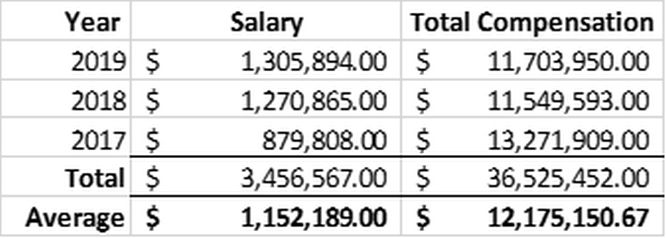
    According to Notice of 2020 Annual General Shareholder Meeting and Information Circular, his total compensation averaged over $12 million per year from 2017-2019. Here is a breakdown:


    According to Rogers, CEO Joe Natale also sits on the Board of Directors at both The Hospital for Sick Children and Soulpepper Theatre Co.

    I wonder if Mr. Natale refers to sick children as “consumers” as well?

    1 https://www.pm.gc.ca/en/news/news-releases/2020/11/09/connecting-all-canadians-high-speed-internet

  • Uptown, John Lennon Imagined. Midtown, Fran Lebowitz Pretends.

    Fran Lebowitz is one of those people who is famous for being famous. She’s not quite as vapid as the Kardashians, but she is of that type. Much like it is difficult to compare athletes from one era to the current one, was Gretzky better than Richard, for instance, one might ask “which angry, sad princess is more boring, Fran or Kim?”

    I knew that going in, but I took in the second episode of Pretend It’s a City because I heard from a trusted source that this particular slice of indulgent pie contains tasty jazz stories.

    A more apt description of those 32 minutes was having lunch with Fran, she is the only one who talks, and she only talks about herself, and you better goddamn realize how fortunate you are to be in the presence of Ms. Lebowitz.

    There was a time when you could get a similar experience simply by walking past a crazy person on the street or riding public transit. It’s the same sort of one-way conversation, more sad than civil.

    Spike Lee, whose batting average for making good movies is well below The Mendoza Line, makes an appearance, and that should come as no surprise. After all, you can’t bake a cake without flour, and you can’t have a proper meeting of this particular flavour of egomaniacs without Mr. Knicks himself.

    True to form, Spike Lee calls jazz legend Charles Mingus “Charlie”.

    Of course, he does. Spike is an “insider”, man. He owns all that culture, don’t you know? I’ve read words written by Sue Mingus saying that nobody called Mr. Mingus “Charlie”. Nobody except Spike Lee, apparently.

    In other words, Mr. Lee is appropriating Mr. Mingus, and by doing so he is doing a gigantic disservice. Instead of engaging with Ms. Lebowitz, maybe displaying a sense of wonderment or even appreciation for Mingus and his work, the two use his name the same way Paris Hilton might use the word Gucci.

    “That purse is mine“. “That jazz is mine“.

    I suppose that should come as no surprise, coming from a man who reduced the life of one of the most important civil rights leaders ever into a disposable fashion statement, X baseball caps.

    I can’t help but think of the word usurp here, because maybe it is the correct one to use. When Lebowitz tells of being run out of a bar and chased halfway to Central Park from The Village by Charles Mingus, she makes it all about her. She tells it as if it was her story; she is so important that a jazz legend left his performance to attend to Ms. Lebowitz.

    “Look, I did that. I got Mingus to chase me for 20 blocks in Manhattan. Look at ME!”

    Malcolm is “A Spike Lee Joint”, Mingus is a brand that Lebowitz owns, and we are all very fortunate that these two have gifted us such wonderful swag.

    There’s an old William Burroughs routine about being wary of vampires. “Old Bull Lee” basically warns that “they want to take everything” and wonders “Why should they get anything?” Lebowitz is basically a vampire on the loose in Manhattan, even looking the part. She not only sucks on cigarettes, she sucks the life and celebrity out of other people, making them and their fame her own.

    Listening to Lebowitz’ stories made me feel dirty and uneasy, kind of like hearing a comedian tell another comedian’s jokes. Sure, it is enjoyable on one hand, but it is ultimately dirty and wrong.

    And while on the topic of comedy, at one point it seemed to me that Fran seemed to almost morph into an original and successful comedian. Towards that end, perhaps that is a concise and clear summary of Pretend It’s a City: Fran Lebowitz is a Poor Man’s Gilbert Gottfried.

    In the end, we might as well see Fran in front of a mirror, admiring herself as she smokes the greatest cigarette ever, admiring herself as she smokes it better than perfectly, all the while admonishing everyone else in the world who smokes for doing it completely wrong.