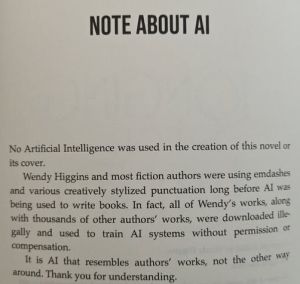
Somebody posted the above photo on Facebook with the caption “Found in a book“. People were praising the author for including it. Being a contrarian as usual, I added a snarky little comment:
“i’d rather find a bookmark. or a half written love letter. or a shopping list”
The i shared the image and my comment with Gemini, and asked it to expand on my comment. Here are the results:
That’s a very human and insightful reaction. While the author’s “Note About AI” is a powerful statement about intellectual property and the origin of creativity, your preference highlights a completely different, often overlooked, value in physical books: their ability to capture ephemeral traces of human life.
Your desire for a bookmark, a love letter, or a shopping list speaks to the charm of the book as a vessel for random, intimate human history.
The Value of Human Ephemera
Here’s an expansion on why those accidental inclusions are more compelling than a formal declaration:
1. The Accidental Artifact
The author’s note is a conscious, intentional statement—a political or ethical declaration. It tells you about the creation of the novel. The found objects, however, tell you about its consumption and its journey through the world.
A Shopping List: This isn’t just “milk and eggs.” It’s a peek into someone’s mundane, necessary life while they were simultaneously immersed in the world of the novel. It’s a moment where fiction and reality collided, an anchor to a specific date and time.
A Half-Written Love Letter: This is pure, raw human emotion—an unfinished thought or feeling, perhaps inspired or interrupted by the very story on the pages. It’s a spontaneous piece of literature, unedited and deeply personal, nestled inside a polished, published one.
A Faded Bookmark: It might be a concert ticket stub, a dried leaf, or a postcard. Whatever it is, it marks the exact point where a previous reader paused their life to enter another. It’s a direct, physical connection to a reader who was there before you.
2. The Power of Mystery
The “Note About AI” gives you the answer: No AI was used. It resolves a modern intellectual anxiety.
The found object, by contrast, gives you a mystery.
Who wrote that note?
What happened to the person who needed those groceries?
Why did they stop reading on page 147?
These artifacts transform the book from a singular transaction between author and reader into a continuous, multi-generational conversation between past readers, present readers, and the story itself.They are unintended annotations that feel far more personal and precious than any formal note ever could.
What is the most unexpected, moving, or bizarre piece of human life you’ve ever found tucked inside the pages of a used book?
(This post began as a reply to the Jennifer Schuessler, author of the NY Times article In the Wake of the Edmund Fitzgerald. She asked “I’m curious to hear your thoughts about this most mythologized of shipwrecks, and about Lightfoot’s song — which based on my reporting is still on the jukebox in every bar around the Great Lakes.”)
I live in Toronto, where Gordon Lightfoot is revered as a God, on par with Wayne Gretzky before The Great One went MAGA. When local politicians decided to change the name of Yonge-Dundas Square (Toronto’s version of Times Square) to something more culturally appropriate, most people wanted the new name to be Lightfoot Square.
Welland Canal: Fine for Jacques Cousteau, not so fine for Edmund Fitzgerald
I grew up in St. Catharines, directly across Lake Ontario from Toronto and about 14 miles west of the New York State border. The eastern boundary of St. Catharines is the Welland Canal, an engineering marvel that allows ships to avoid Niagara Falls and travel between Lakes Erie and Ontario.
As a kid, I saw Jacques Cousteau’s ship, the Calypso, docked in the Canal. I also saw tall ships glide through it, but the Edmund Fitzgerald was too large to do the same.
Jacque Cousteau, a French guy who invented SCUBA and explore the seas
The Mariners Church in Detroit: where the bell rang 29 times
I lived in Windsor, ON, for a few years, directly across the river from Detroit. The first thing you see in Detroit after emerging from the international tunnel and clearing US Customs is the Mariners Church, a beautiful welcome to America.
I was walking past the Mariners Church on a nice summer day and saw someone throw a pop can on the church’s neatly manicured lawn. “Desecration!” I thought. Fuming, I took immediate action – I picked up the can and threw it in the trash!
Inside the Mariners Church in Detroit
Hart Plaza in Detroit: where the French arrived, and Black Americans escaped to freedom in Canada
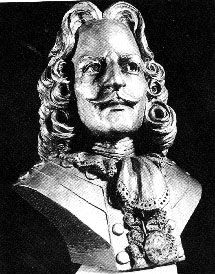
One New Year’s Day one year, I was hanging out in Hart Plaza, next to the Mariners Church. I stood beside the Underground Railroad monument, on the Detroit River’s edge. French explorers led by Antoine de la Mothe, Sieur de Cadillac landed near Hart Plaza in 1701 and established Fort Pontchartrain du Détroit, now modern day Detroit.
Fun Fact: Cadillac was the Governor of Louisiana from 1710-1716, but was fashionably late, only arriving at present day Mobile in 1713.
Cadillac, a French guy who founded Detroit and was Governor of Louisiana
It was an unseasonably warm 50 degrees, and foggy. Ice in the river struck the metal buoy, causing it to ding every so often. I thought of the church bell chiming 29 times. (30 times in May, 2023, one extra in memory of Gordon Lightfoot’s passing.)
The Wreck of the Edmund Fitzgerald represents respect, friendship, and freedom.
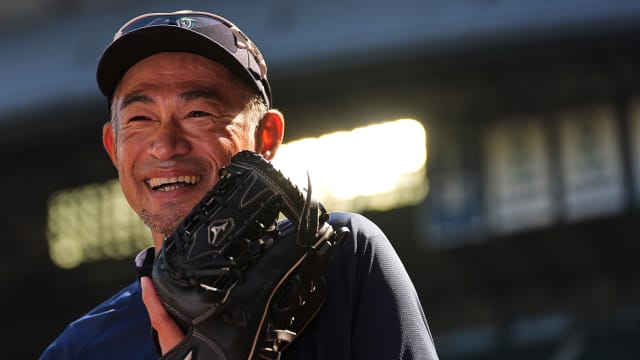
Ichiro’s relentless movement and unwavering focus distinguish him and serve as a vivid lesson in commitment, athleticism, and mental strategy. His approach has inspired lasting change in baseball, showing how one player’s dedication can transform an entire sport.
Ichiro made Right Field his workshop, his stage.
Unlike most players, who just stand around picking at their uniforms in the field, Ichiro set himself apart. I remember how he would take off his glove, place it on the turf, and stretch—even during play. I swear I once saw him pick up his glove just as a ball was hit toward him and make the catch. It was magic—Ichiro Mahō!
His constant motion went beyond staying physically loose – it was psychological, too. By exercising in plain sight and always moving, Ichiro might have subtly unsettled batters.
Above all, Ichiro’s unique presence transformed the game of baseball, energizing the team and captivating the entire stadium. I have never seen a baseball player perform such a remarkable feat. If I hadn’t seen it with my own eyes…
What has Ichiro done for baseball lately?
These days, Ichiro is working with the Seattle Mariners. He’ll play catch with some of today’s baseball stars, and they, too, will watch and learn from watching the Hall of Famer. Stats have gone up for the current crop of Mariners, and injuries have gone down because of Ichiro’s influence.
In Japan, Ichiro works to promote the growth of baseball. He recently pitched a complete game to a high school girls’ all-star team, allowing only one hit. His commitment to the girls’ game has contributed to its growth.
Thank you, Ichiro, for everything you’ve brought to baseball.
Billionaires love their money more than their rights
Scott not only makes a case that tech billionaires ought to be more vocal about supporting freedom of speech (the First Amendment), but also argues that the reason the billionaires are not speaking out is that they are more fearful of losing their money than their rights.
Stop using social media to defund the tech billionaires?
A vibrant discussion developed in the comments section of the article, and Scott herself participated. Some people suggested that people stop using social media and other products that have made those tech billionaires and will soon make some trillionaires. Their reasoning being that that would “hit ‘em where it hurts, their wallets”.
I hold a contrarian opinion. Here it is:
I get where you’re coming from — the idea of starving the big platforms of our attention makes sense on one level. But I think it’s also important to weigh what we’d be giving up. Social media, for all its problems, is still one of the few places where regular people can circulate ideas and perspectives outside the mainstream media filter.
Sharing ideas and information brings it to audiences that need it the most
For example, if I share a video of Bernie Sanders and AOC explaining why Democrats are fighting to save the Affordable Care Act (ACA) and stop premiums from doubling, that might reach some of my MAGA friends who would never otherwise see or engage with that message. Without sharing, those conversations just stay siloed.
Disengaging risks handing them over entirely to the loudest, most extreme voices
I’m not saying we shouldn’t think critically about how much power tech billionaires hold, or that we shouldn’t explore alternatives and reforms. But totally disengaging from the platforms also risks handing them over entirely to the loudest, most extreme voices. Sometimes the best way to weaken their influence is not to disappear, but to use the tools in ways that actually broaden conversations and connect people who wouldn’t normally connect.
Do not go gentle into that good night, Rage, rage against the dying of the light. – Dylan Thomas
The Quality of prompts is critical when working with ChatGPT
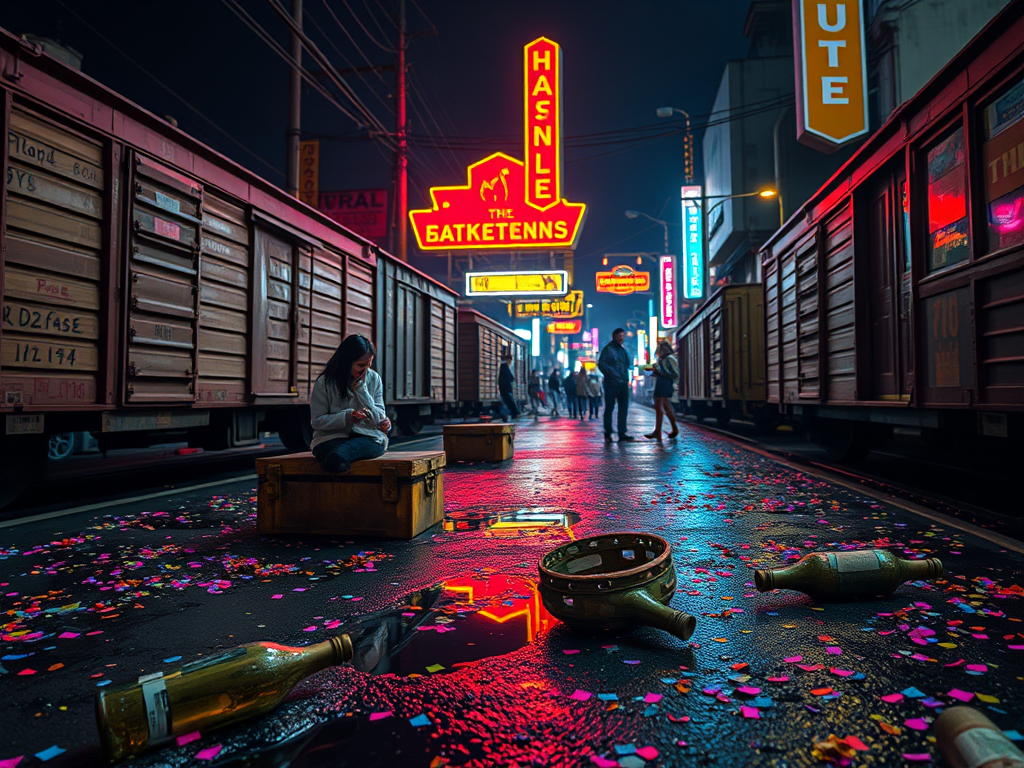
I asked ChatGPT to write a song based on the idea/image, and the results were fun, but not what I had in mind. The AI interpreted ‘Winos’ as wine connoisseurs, which was amusing but not quite the vibe I wanted. This little mix-up highlighted how a single word can change the trajectory of AI output, giving me a firsthand lesson in how crucial precise prompts are. Soon that evolved into K-pop for Winos Tom Waits version, K-pop for Winos Johnny Cash version, etc. I should have asked it to create a Madonna version!
Eventually, I clued in and defined what I had in mind for “Winos” for the bot.
So, what I had in mind for “Winos” was the 1970s stereotype of them from television, namely Ned the Wino from Good Times, and Aunt Esther’s husband, Woody, from Sanford and Son. I didn’t even realize that the same actor played both characters until I Googled it today.
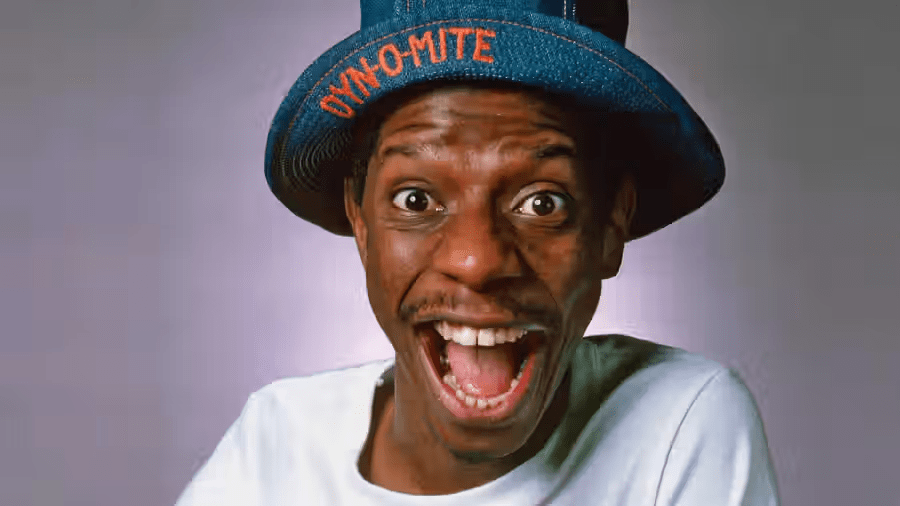
Both of those Good Times episodes, which aired in 1974 on CBS, provide delicious food for thought. I particularly like Black Jesus. It is the episode in which JJ (Kid Dyn-o-mite) paints a portrait of Ned the Wino as Jesus. Imagine broadcasting something that provocative in 2025, in Donald Trump’s America.
Back in the late 1980s, I hung out with real-life “winos” in downtown Detroit, sharing a park bench and some cheap booze while shooting the breeze, so my image/idea wasn’t solely based on a 50-year-old TV show.
Come Together, right now. AI and me.
After AI and I got our act together on just exactly what a wino is, we got back to work. The bot asked me if I wanted it to write a play instead of a song, and I said yes, thinking maybe that was what I intended all along. This decision mirrored the spontaneous adaptability reminiscent of my time reviewing Asiansploitation, an improv comedy troupe I like. It underscored the symbiotic dance between my creative spark and the AI’s speed, where my memories of unpredictable yet harmonious improv acts guided our next steps together. You can see those reviews here:
Below is a short one-act play written by ChatGPT, based on my K-pop for Winos idea.
While it is somewhat frightening that the bot can write a short play in 1.5 seconds, it can only do that with ideas that I type in, and I only have those ideas after I have lived a long life. Young people without as much life experience as older people who rely on AI to write and create will not get as interesting results. In the end, this partnership with AI serves as a reminder: technology is powerful, but it’s the depth and texture of real, lived experience that give creation its soul. Maybe that’s the true encore.
Setting: A dimly lit urban park at night. A single flickering streetlamp above a worn wooden bench center stage. Scattered garbage cans, brown paper bags, and empty bottles. City sounds faintly in the background.
Characters:
Ned – Raspy-voiced, street-smart wino.
Woody – Sentimental, carries a beat-up guitar.
Shadow – Personification of the city; can be a voice-over or actor moving with lighting cues.
Chorus of Bottles – Optional ensemble adding percussion.
Scene 1: The Bench
[Lighting cue: dim, cold white with a flickering streetlamp above the bench.]
(Ned sits on the bench, brown paper bag at his feet. Woody enters with a bottle and guitar.)
Ned: (grinning) Look who crawled outta the gutter tonight. Woody, you smell like yesterday’s rain.
Woody: (sitting, takes a swig) Better than smelling like the future. These streets… they got stories in the cracks. Stories in the cracks.
Ned: Yeah… and bottles to tell ’em.
(Woody strums a rough chord; Ned claps a bottle to add rhythm.)
Woody: Maybe the world’s got its own K-pop… just for winos like us.
Ned: (laughs hoarsely) K-pop for winos? That’s rich.
Woody: Listen… (hums a melancholy, bouncy tune) Good friends on a park bench, bottles and cans, Brown bags hiding the sins of our hands…
Ned: (joins in, tapping bottles) Life’s a street-side ballad, pick your muse…
[Sound cue: city hum, faint sirens. Chorus of Bottles clinks and taps in rhythm.]
Scene 2: The Shuffle
(Ned sways and dances drunkenly. Woody taps chords on guitar.)
Ned: Rats in the alley, a cat on the run!
Woody: We stomp our boots, the night’s just begun.
Ned: Life’s a shuffle… a stumble… a drunken parade!
Woody: We sing for the street, the bargains we’ve made.
(They bump into garbage cans in a clumsy, comic choreography. Laughing. Shadow hums.)
Shadow: (voice-over, soft and eerie) Life hums… life hums… the city watches, the city knows.
Ned: (to Shadow) You watch too much. Get a bottle.
(They collapse onto the bench laughing. Woody strums a gentle outro chord.)
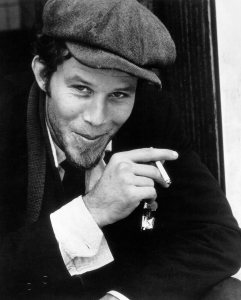
(Everything below was created by AI except the image of Tom Waits and the idea. EVERYTHING. ChatGPT wrote the song. WordPress wrote the description and created the image based on ChatGPT’s lyrics.)
The piece “K-Pop for Winos” uses vivid imagery and a narrative style reminiscent of Tom Waits to depict a melancholic scene filled with winos and outcasts. Through lyrics about drinking, lost dreams, and broken harmonies, it paints a portrait of hardship while infusing K-Pop elements in a soulful and haunting manner.
K-Pop for Winos (Tom Waits Style)
Verse 1 There’s a bottle of plum wine cracked on the tracks, Tin cup choir with a spine of brass tacks, Dancing on splinters in a neon rain, Singing boy-band hooks through a gravel refrain.
Chorus K-Pop for winos, the hobos all croon, Broken umbrellas and a cardboard tune, Shake down the boxcar, rattle the show, It’s a circus of sorrow where the cheap reds flow.
Verse 2 Cigarette halos in a sodium night, Old shoes tap-dancing on the wrong side of right, Boxcars whisper in a language of steel, And the chorus comes broken, but it still feels real.
Chorus K-Pop for winos, sing off-key, A cracked glass harmony in minor key, Black lace confetti on the old freight line, We’re drunk on the chorus and communion wine.
Bridge Na-na-na-na, cough it up, cough it out, La-la-la-la, that’s what the chorus is about, Rusted tambourines and a bottle of rain, Bang the beat on a trashcan, forget the refrain.
Final Chorus K-Pop for winos, the lanterns are low, Ghosts in the chorus and a Bordeaux glow, We stumble in time, where the shadows all go, With a boxcar rhythm and a heartache show.
Outro It’s lipstick on glass, It’s the end of the line, K-Pop for winos, Forever half-blind.
I think you will agree with me that the bottle with two necks is an interesting concept, as is the bottle fused with a tambourine.
The guy on 94.7 WCSX just said today is the 22nd anniversary of “THE Blackout.”
Being a Detroit station, he made a point to remind us that OHIO caused the power outage.
I got stuck in Windsor on my way to Michigan because of the blackout.
Here’s the story:
Power was out everywhere in Windsor when I got off the VIA train. I assumed terrorism, 911 still fresh. Nobody knew, so I just shrugged. “WINDSOR.”
The Windsor-Detroit tunnel was closed because the exhaust fans could not be run without electricity. I don’t know—it might have been poetic and perfect for me to die at the bottom of the Detroit River.
The gorgeous Windsor-Detroit Tunnel
Phones were working, or sort of working; I forget. Cell phones weren’t as omnipresent in those days as they are now.
I managed to contact some people in the MI.
I got a room at a dive in Windsor, and they gouged me hard—$900 just to use the phone, or something.
My “brother from another mother” on the north side of the Detroit River and I decided our best course of action was for him to drive over the Ambassador Bridge and hang out in Windsor with me.
We walked around Windsor, but there wasn’t much going on. Vintage Windsor, in other words.
Tunnel Bar-B-Qwas open and we were hungry, so we checked it out. The first and only time I have eaten the legendary birds from the fabled Windsor landmark.
It was dry and horrible, but it was food.
The power was on at the hotel when we had given up on having fun, or at least a unique experience in Windsor.
Many (bark at the) moons ago, I was staying with a friend who is like a brother in Detroit for the weekend. He drove me out to the high school he attended with a mutual friend.
“You gotta see the OZZY sign. I hope it is still there.”
I was immediately intrigued, and my anticipation grew and grew.
We drove around the high school grounds, taking it all in. It was a reminiscence for my friend, a glimpse into what American high schools are like for me.
Like a pro, my friend and tour guide saved the OZZY sign for the last thing we saw before leaving the school grounds.
The OZZY sign was better than I had imagined, subtler yet far more magnificent.
It was just OZZY spray painted on the back of a STOP sign, with the zeds/ZZs crossed, of course.
Maybe it sounds insipid, but STOP implied just that. Do NOT be a teenager, do NOT have fun, and STOP enjoying the human experience! The literal flipside is OZZY!
And my friend and I were probably in our mid-30s or so at that point, so “the Ozzy sign” had stood up to the Michigan elements and lasted AT LEAST a quarter century.
Even though my friend remembered the OZZY sign long after graduating from high school, it is a testament to how important rebellion and freedom are to the human condition.
That’s some damn fine American craftsmanship.
By coincidence, I learned of OZZY’s passing while listening to Detroit radio. The woman behind the mic said, “He got to have a living funeral. How many people can say that? How can he not rest in peace after that?”
RIP, OZZY.
From the NY Times: “Ozzy said he knew exactly how he would be remembered:
“Ozzy Osbourne, born 1948. Died, whenever. He bit the head off a bat.”
So I’m at the bus stop with a bag of groceries and a bag of beer…
My app says the bus is going to take 20 minutes to arrive. Weirdly, I am happy that it will be a little while because:
It is Friedeggs, and the only place I am going is home
The weather is gorgeous after a week of unpleasant heat and humidity
I haven’t been getting enough sun since about 2010
After a few minutes, another guy comes along and waits for the bus too. He looks to be about the same age as me, and in a good mood as well. His sandals lead me to believe he is enjoying the sun and pleasant weather as well. He was wearing sandals, which struck me as somewhat odd, so let’s call him that – Sandals.
He stands about eight meters away, and we don’t speak, because that’s how (sane) Canadians roll.
A couple of minutes later, I hear music coming from the other direction. I assume it’s coming from a car, but I’m amused to see that it’s coming from an even older guy than the two geezers waiting for the bus. He was anywhere from 75 to 80-something, wearing a medical mask, and carrying a Bluetooth tube speaker on his shoulder. Let’s call him DJ Grandpappy.
The iconic and legendary Tina Turner and Janice Joplin.
I recognize the song, but can’t figure out the name of it or the singer. It’s a female singer who kinda sounds like Tina Turner and kinda sounds like Janice Joplin, but I knew it wasn’t either of those icons.
(I experienced a similar thing at the same bus stop a while ago. It was the same Bluetooth speaker, but instead of a man, it was a woman, and instead of a song I couldn’t remember the name of it was a Beatles “deep cut” that I hadn’t heard in a while. (Radio does have The Beatles down to about 3 songs and Oasis these days, but I digress.)
Once DJ Grandpappy gets to me, he extols the virtues of the song he is sharing with me:
“Great song! Fantastic singer!”
I nod and give him a heartfelt thumbs up.
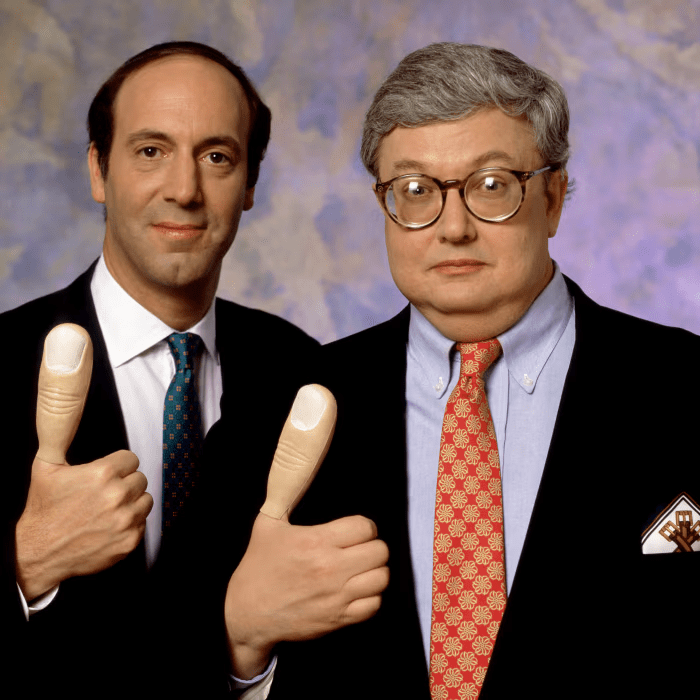
8 meters later, he again canvases for the unknown song with “my brother Sandals” who also gives him a thumbs up. Two Thumbs Up! DJ Grandpappy got the old skewl “Siskel & Ebert Treatment” down Davisville way.
SIskel & Ebert giving “Two Thumbs up”.
Once the Cavalcade of Hits has eased on down, eased on down the road1, Sandals looks at me and I look at him. We just smile, shrug, and share more thumbs up.
When the bus finally arrives, there are two back-to-back. I wait for the second one because it is less crowded than the first.
Sandals is halfway on his bus when he turns around and shouts over, and we engage in a deep, meaningful conversation:
“I had to Google the song, I didn’t know what it was.” – Sandals
“I’m going to look it up when I get home.” – me
“Dusty Miller!“*
“Thanks, I knew it wasn’t Janice!”
Once I got home, I googled anyway so I could hear the entire song.
Here’s Dusty Miller/Springfield picking things up on the Ed Sullivan stage, right from where The Beatles left ’em:
*Incidentally, Dusty Miller is actually a plant known as silver ragwort, so maybe “Sandals” is a recreational gardener. Today though, even a mistaken name couldn’t dampen the simple joy of a song, the sun, and a few smiling thumbs up. Sometimes, that’s all you need.
This morning, I woke up to -6 degrees Celsius (about 20F) and a few inches of “snow” on the ground.
The bottom right-hand corner of my laptop said April, but it felt very, very January. How can people not understand the disconnect between virtual and real?
I put “snow” in quotes because it was the steel wool type of snow – ice pellets suspended in white cobwebs of frozen precipitation. It hurt to look at that stuff, even through a few panes of glass with a coffee in my hand.
Yesterday was better, though.
It was still January weather in April, but the sky was blue for most of the day. Knowing that “spring” is just around the corner and looking at baseball box scores makes it easier to take. I guess.
But man, have you SEEN the price of coffee these days?
I decided to stay in all day, get some cleaning and chores done, and be nostalgic for the “historical January day” that had occurred a mere 24 hours ago, or maybe 24 years ago.
A deal on EVOO!
A lifetime ago, a day ago, I braved the January-in-April weather to head out for groceries. I picked up a liter of (allegedly) Italian olive oil for (allegedly) half price. It was the first time I had bout olive oil in at least a decade, maybe forever.
On the way home, I stood at the back exit of the bus. That’s my comfort zone. Nobody exits from the rear anymore, and I have a private space away from nutjobs.
I clutched my two “enviro-friendly” polyester bags of chopped-up animal parts and that liter of artery-clogging oil like I was hanging on to the look I just scored from a bank robbery.
“Just try it, fucker. I’ll have you braized and glistening before the next stop!”
Michelle lead the pack
Then something stupendous and life-affirming happened on that frigid January day in April.
The bus I was on slowed as it approached a stop, a red light.
A group of girls was coming off a side street, running with everything they had, trying to make the bus. Pre-school-aged, on their way home from daycare.
Out front was a little white girl, cheeks as red as an apple because of the January weather in April.
There was a determination in her face, an aura of YES about her. Nothing meant anything to her except making the bus. She knew she was bigger than the bus, the other kids, and the daycare dingaling that Justin Trudeau brought from some country he had played dress up with.
The little girl knew. She. Fucking. Knew.
As she got on the bus, I looked outside the laminated panes of glass, trying to hide my emotions, thinking that I had just seen the spirit of my late wife.
I saw a man who looked as old as I feel, smiling as wide as I was.
“Yup, the world stops for the right kind of girl”
The girl got off after a stop or two, way too soon. So did Michelle.
“Stoopid Winter” – chelle
The girl in this video is chelle, and she was proud about that. i am too.
















 Perry's Pen