(This post is a “response” to an article by David Treuer that appeared in the 2026-09-02 NY Times entitled I Went to Princeton in Search of Greatness and Came Back Mediocre. Treuer tells of being an “Indian” from Minnesota who goes to Princeton as a student in 1988. It is a great article, and you should read it. There’s an AI summary of it below.
I could relate deeply to Treuer’s story, but in the reverse order: when I left my “reservation,” I was welcomed. I felt born again and blossomed. I met lifelong friends from Michigan, and I even met my wife there. Sadly, living in Canada now feels as oppressive as it did when I was a child, with the Elbows Up crowd patting themselves on the back for insulting my friends and family: Americans.)
Growing up in Canada, at least in southern Ontario and in the Toronto media market, is like growing up in Princeton, or at least in the Princeton described in this article.
Social mobility is very limited in Canada, and those who are born into the ruling/elite classes look down their noses at others, especially Americans. The upper class looks down at the United States as if they are “savages on a lawless plantation,” and they base all that on what they see on TV news out of Buffalo.

My dad worked on the assembly line at Ford, and I very much did not belong to the ruling “Princeton” world. And as much as I didn’t care for the rulers, they very much didn’t care for me.
So I got out, got out as far as I could, and sought out the “reserve”, the savage and lawless America. I did so by going to college in Windsor, which allowed me to take a short ride on a bus under the Detroit River and visit “the reserve”, the land so looked down upon by the people who looked down upon me. I felt a kinship with America before even submerging myself in late ‘80s downtown Detroit.

Downtown Detroit was a greyscale ghost town in those days, but a vivid, technicolour memory I have is visiting a shop selling African beads and things. I ventured in, and the staff was all female, until a man walked out from the back to greet me. I probably looked like a cop, but he took the time to chat for 20 or 30 minutes. I told him I was hoping to learn about Malcolm X because I couldn’t find anything in the libraries I frequented. He recommended Malcolm X Speaks. Nearly 40 years later, I still treasure that paperback.
The elite Canadian gatekeepers who dismissed and disdained me would never have ventured into that Black-owned and operated shop, let alone had a life-changing discussion and brought home a Malcolm X book. (The calculus teacher I had who referred to Americans as “you alls” might have finally gotten what he had coming to him if he poked his head in, though!)
I also made American friends for life during my years of visiting Michigan. We sleep at each other’s houses in Dearborn, Michigan, Davisville in Toronto, or Park Slope, Brooklyn. We vacation together, and we exchange gifts all the time. Heck, I have been to three weddings in America, been a part of the wedding party for two, and once served as best man!
Can you imagine a person from Princeton spending the weekend at a friend’s house on the reservoir?
If I had allowed the Canadian Princeton wannabes to crush me like they crushed so many, my life would be so incredibly empty in comparison. I can’t imagine myself even being alive if I hadn’t explored the “savages on their lawless plantation.”
But the judgmental Canadian elite were, and are, still better than all that. In their minds, anyway. And hey, they get to have their Elbows Up campaign, and pat each other on the back for insulting my friends and family who happen to be American. The Canadian Princeton wannabes get Mark Carney to boot.
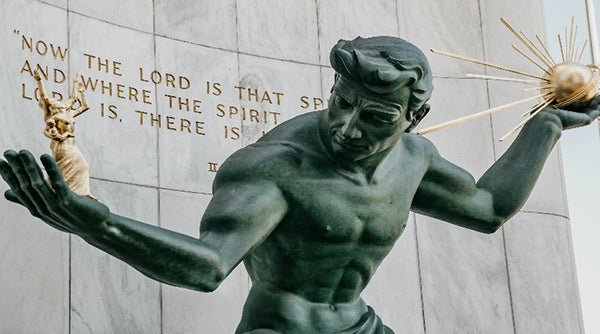
Photo of “The Fist” in downtown Detroit by @colindetroit

Here’s a summary of the article “I Went to Princeton in Search of Greatness and Came Back Mediocre” by David Treuer*:
David Treuer reflects on his journey from the Leech Lake Reservation in Minnesota to Princeton University, delving into the complexities of identity, expectation, and belonging. As a young man, he believed that escaping his impoverished reservation was necessary for greatness. At Princeton, however, he found that his Indian identity made him an object of fascination, with peers and professors expecting tales of suffering and hardship. Treuer felt compelled to fit these narratives, even fabricating stories, only to realize how this distanced him from his true self and community.
Over time, Treuer came to see his home not as a place defined by failure, but as a real and complicated community rich with ordinary lives. He recognized the false binary that painted Native life as the opposite of American life. Rejecting both the roles of cultural tragedy and exceptionalism, he returned to Leech Lake and embraced a “so-so Indian life”—finding meaning and happiness in the everyday realities of his people. Ultimately, Treuer discovered that fulfillment and self-understanding came not from pursuing greatness elsewhere, but from accepting and valuing the ordinary complexities of his own community.
*AI generated.
Leave a Reply